
As an outside observer, the WSU Office of Research has three readily-accessible content lines for external audiences:
- Research.wsu.edu/news/: Fast- but irregular-paced news releases summarizing recent publications
- WSU Insider magazine: Print and web content released at a slower pace than Office of Research News, though some stories are cross-posted at news.wsu.edu and research.wsu.edu
- Social media accounts: LinkedIn is the most active, but research from WSU is regularly posted by Pullman- and WSU-affiliated accounts, like @pullman.unlocked on TikTok, as well as @wsu.urc (Undergraduate Research Club) and @gradschoolwsu (WSU Graduate School) on Instagram.
As a former inside observer, I can add readily-accessible content lines for internal audiences:
- Research lifecycle and management guides
- Internal links to research-related offices at WSU
- Near-boilerplate language for students and faculty disseminating their research
A growth-oriented content strategy for a Communications Coordinator would build on this foundation to create content at three velocities:
- High-velocity content for brand awareness and engagement.
- Medium-velocity content for grant- and donation-seeking activity
- Low-velocity content for authority-building
High-Velocity Content
High-velocity content would build on the current LinkedIn model by replacing the shortlink to a /news/ page with some other proof-point:
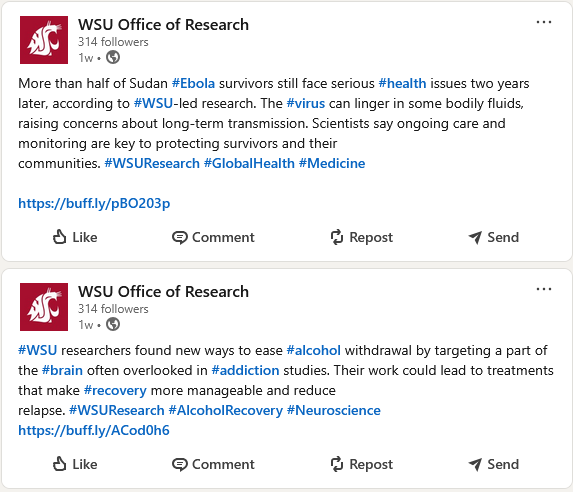
- Simple, broad-value statements describing the findings and application of recently published/presented research.
- Proof-point of that research
- Short-form video interview (or VO + b-roll) with researcher(s)
- Infographic produced in concert with researcher(s)
- Link to external publication (conference proceedings, external reporting)
This approach would be focused on building an audience rather than driving traffic. It would provide a low-effort route to promoting the work of researchers at WSU.
Unseen goal: This approach would also provide an easily shareable resource for the researchers themselves, helping build their credibility and audience (critical for junior faculty and graduate students) as well as WSU’s second-party contacts.
The other platforms
This approach is weakly suited to LinkedIn, but it would be particularly useful on slow news days or for researchers who prefer this route.
Externally-Facing Short-Form Video
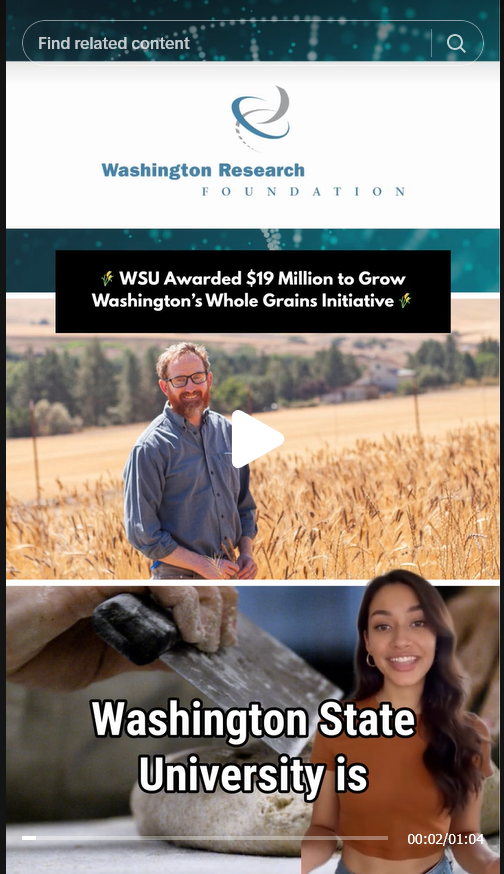
- @pullman.unlocked shows a small following for research-based content, but the account is run by a local realtor.
- An account run by the Office of Research focused on promoting WSU researchers could easily build from this connection (especially if Jordan Vorderbrueggen is willing to work together for some joint content early on)
- The frequency and volume of work produced by WSU researchers is a content goldmine, if video content can keep up
- This presents a significant opportunity to work with the researchers themselves or with students in related majors/career paths to produce this content
- This content can easily be repurposed to YouTube Shorts, Facebook Reels, and Instagram
Internally-Facing Short-Form Content
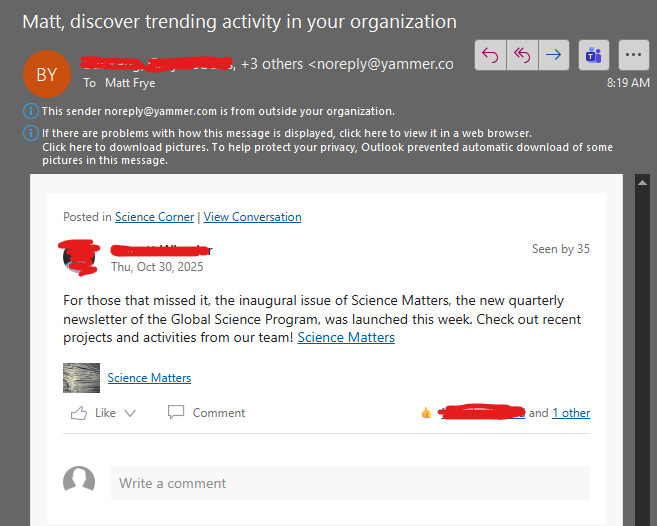
- Intra-organizational social media is not a hugely popular tool, but it is likely already developed and available.
- I described the concept to my oldest child when she saw me checking my email. She said “that sounds cringe.”
- Despite that negative review, I’d propose using an existing internal social media space or simple, weekly newsletter to repeat and highlight the high-velocity content from other platforms
The intent of internal content would be to first build visibility of the Office of Research’s outbound content among internal stakeholders. Increased faculty reactions to social media content would build second-party connections and (ideally) increase follower counts.
The secondary goal would be to break down silos by visibly putting more researchers in one location.
Method: Avoiding overwhelm and burnout
This material would be produced once and reused with minimal modification across several platforms. Excluding video content with speaking humans, verbal material can be drawn from publications or researcher descriptions. Graphic content may be sourced from existing WSU photography collections or stock material sites.
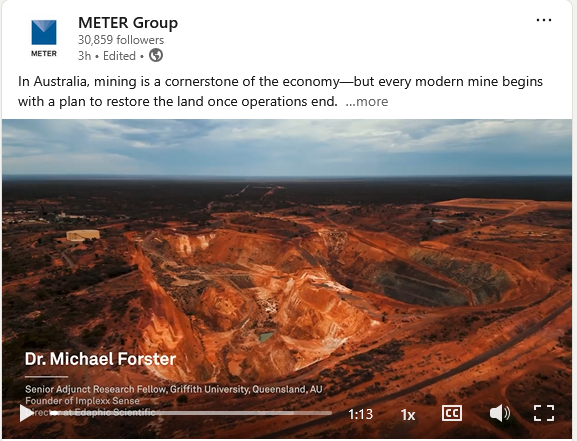
Example: Simple podcast VO extraction + stock footage
- 60-second segment of an interview delivered for another piece of collateral (archival)
- Stock footage with related concepts
Video content with speaking humans (e.g. interviews, candid video of research sites) would be a later goal and would likely require student workers.
