
A customer story highlights a specific customer application of a product, service, or solution. They are used to demonstrate value in a way that a product description or simple testimonial cannot. They can be written in different structures or styles, but they tend towards a journalistic or blog-like structure, which makes them a more entertaining read than a product page.
As marketing collateral, these stories serve several purposes. While they can support material designed to convert, stories themselves are not designed to convert an audience from reader to prospect or from prospect to customer. That nudge has to come from another source.
Customer stories can support that nudge in several ways. They are excellent educational content for a business website because they show a product or service in action. The examples on this page emphasize a several products, a company customer service ethic, and a narrative that walks from problem to solution to show additional value to a customer. Social media posts, even threaded Twitter posts or long-form LinkedIn posts, cannot convey the same level of detail. Email is not an appropriate place to hold a reader’s attention for 800-1500 words. Product pages are also inappropriate for detailed stories of how to combine several products or services to solve a narrow problem.
Customer stories provide a mechanism for sharing extended details without breaking the boundaries of those media or the goodwill of your audience.
Need an Example?
Read a story promoting customer service and electric substation panel manufacturing.
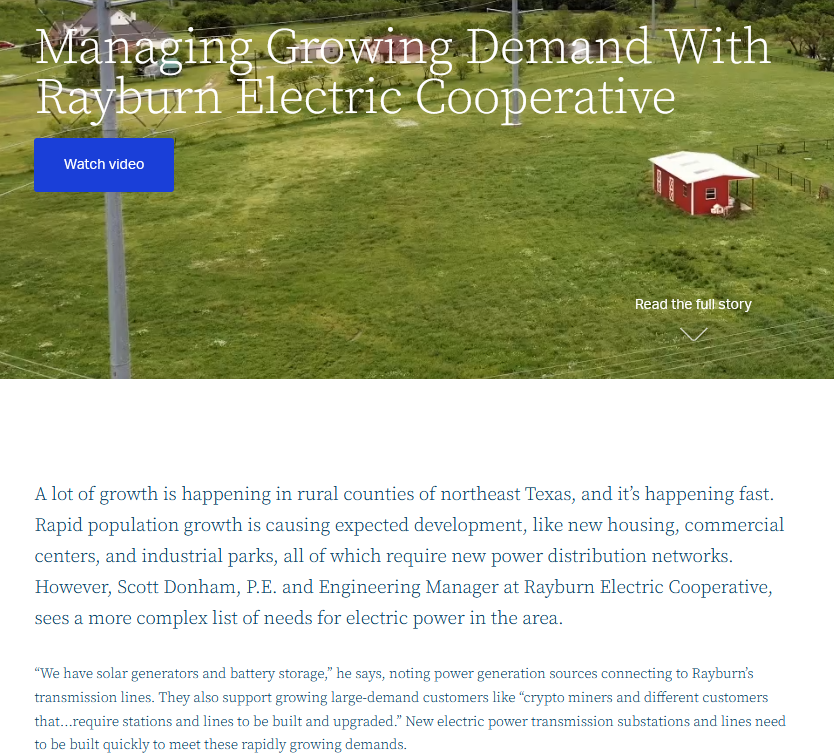
This customer story was designed to attract readers interested in a variety of things: infrastructure development, substation panel manufacturing, protective relays, and electric grid modernization are all key facets of the relationship between actors in the story. It served as a key collection point for audiences, who were drawn from all around the web (via social media posts, digital ads, emails, and more), to ultimately be directed towards a web page I wrote about custom panel manufacturing.
Read about other collateral produced to support and build on this customer story →
Specifics
A customer story, by the numbers.
Length
A customer story runs 1000-1500 words. Any longer than 1500, and you’re probably looking at two or more stories fighting for attention. Any shorter and you might not have enough detail for readers to see themselves in the narrative.
Customer stories should include images, diagrams, videos, or other media to both make the story “real” to readers and provide information that cannot be conveyed easily in words.
Problem, Solution.
A customer story should work from a problem specific to one customer, but that problem should be something other customers can sympathize with—whether because they have had that same or a similar experience or because they are about to embark on their own journey where the experience is likely to occur.
A significant supporting component of a customer story is the background research (often through interviews) necessary to understand the story. These interviews go beyond bills of sale or emails to and from the customer, because the most interesting elements of a story are often the things that seem tangential to the problem.
Time
A good customer story takes significant effort to go from proposal to publication. Interviews should be conducted early, and there should be at least one round of review for both a technical outline (identifying factual details to be shared in the story) and a story draft.
The fastest, smoothest customer story writing process should take at least 7 full work days to complete. Add at least one work day for each round of revision or each interview beyond the first. Video creation, image editing, and other components will add their own time.
Collaboration
Every party involved in the story should be a collaborator in writing a customer story. Because the story will have details about the customers, they should have the opportunity to make sure the story presents them as they’d like. Any organization individuals named or quoted in the story should have a chance to agree to their representation.
Benefit
The end result of a customer story is a bit like a love-letter to a customer. It shows the excellent work they do, as supported by the organization providing the products or services that get them there.
Along the way, the story gets to show how products or services work in the real world, creating an opportunity to share more detail about a product or service than a product page can normally accommodate.
Finally, customer stories are evergreen. Even if the story is about a customer using the Widget 1001 to solve a problem and you’ve just recently released the Widget 2001, the story is still accurate about the old product. You may not sell it anymore, but the story should be an opportunity to share detail about the quality, production time, flexibility, or other features customers will see in the Widget series.
