I’m a writing professional who used to teach Professional Writing. It’s not a direct transition (I taught a lot more types of writing than I do at my job now), but it’s close enough that a pretty good portion of my academic CV made the jump onto my professional resume and cover letter.
This post is a condensed version of how I created a professional resume after spending years carting an academic CV around.
This got to be a long post, so you can definitely jump straight to the final resume or how I generated skill blocks for a functional resume.
Note: I use the word “created” instead of “converted” on purpose. I don’t think you can convert a CV to a resume any more than you can convert a technical manual into an Amazon product page. Use one to inform the other, sure, but don’t expect to open up your CV.docx file and start deleting lines until you get a resume.
The Process
As a note to start things off, one thing I taught in technical writing and professional writing classes was resume creation. I had an advantage in this process because I already knew what the road looked like. When I opened the first job ad that I wanted to send materials to, I knew that I was going to have to complete the following steps, in roughly this order:
- Take an inventory of the skills the job ad wanted. I would spend too much time summarizing my CV on its own and I’d never get to my actual goal if I started with my own document.
- Take an inventory of the skills that I typically used on the job and was praised for in recent annual performance evaluations.
- Identify the overlap.
- Write a short (short!) explanation of how I used each overlapping skill and its outcome in a way the job would care about.
- Make a note of committees or other roles that I could present as “jobs” in chronological resume format.
- Summarize my graduate research in one sentence.
The goal was not to create a perfect resume or even to create a perfect resume resource to keep using in the future. I was teaching more than full time, I had kids, and I was completely burned out. I was building the airplane in the air, and I didn’t have time to fine tune anything as I went along. And, if you look carefully, at no point did I really consult my CV. Your mileage may vary, but my CV just didn’t have enough specific data on skills and outcomes, and if I needed to look at my CV to remember that I could do something, then I probably wasn’t ready to do it on the job.
Inventory of Audience Expectations
I applied for writing positions, for content creation positions (including graphic design and web design), for managerial roles, for editing positions, part time, full time, contract… I applied for a lot of things before I was successful. In general, job ads in my interest area wanted to see things like:
- Ability to produce text or other content
- Audience analysis
- Ability to work on a team
- Ability to work solo
- Ability to learn
- Knowledge of particular styles (e.g. Chicago, AP)
- Ability to learn in-house styles
As I applied and interviewed for more jobs, I found out that I was presenting my skills wrong. I focused on things I knew or understood. What my readers wanted to see were processes and results. Those two structures aren’t mutually exclusive, though. Academics can work on teams (committees), and folks working in Communication departments can usually attach fancy words to the mechanics of teamwork. The trick is being able to connect that knowledge directly to processes (i.e. what you’ll know how to do on day 1) and outcomes (i.e. what the result will be on day 2).
The only reason that I am not including the job ads here is that I neglected to save them in a format that I could use later. I didn’t want to start using habits that went with teaching, because that would turn this into a lesson plan.
Self Inventory
The next step was to go through my annual reviews, my evaluations, the courses I taught, the contract work I did on the side, my research projects, everything I had done for the last few years, and identify specific skills I could pull from. This might sound silly, but I used the same job skills checklist on the Purdue OWL website that I gave students in class to come up with some specific skills I knew I could do.
Out of the materials I had available, I came up with a list that included the following:
- University Culture (recruiter jobs)
- University Recruitment (recruiter jobs)
- Branding (marketing jobs, content writing jobs)
- Communication and Teamwork (content writing jobs, developmental editing jobs, technical writing jobs, proposal writing jobs, remote jobs, university assessment jobs, jobs in large organizations)
- Content Creation and Editing (content writing jobs, editing jobs)
- Technical Knowledge (technical writing jobs, proposal writing jobs)
- Data Analysis (technical writing jobs, grant writing jobs, managerial jobs, university assessment jobs)
- Project Management (project manager jobs, managerial jobs, grant writing jobs, university assessment jobs, mostly solo workplaces)
- Proposal Writing (proposal writing jobs)
- Style Guides (technical writing jobs, developmental editing jobs, content writing jobs)
Those ten skills and backgrounds were spread over the twelve resumes I saved, at 3-4 skills per resume. There were more than a few “quick apply” materials generated and thrown in to pages at LinkedIn, Indeed and other sites.
I also needed some chronology to show that I could stick to a job, but also that I could grow while I was there. Unfortunately, academia doesn’t offer a lot of job title changes, and the job titles I had (“Adjunct Faculty,” “Graduate Assistant” and “Assistant Professor”) weren’t all that descriptive. So, I improvised and looked for committee work I’d done, for research groups I’d participated in, and for departmental or university projects I worked on. Even though my ultimate goal was to find something that I could clock in and clock out of, I wanted to show that I’d do something meaningful with the time in between.
The Payoff
Those first few resumes and cover letters, wow were they rough. I taught document design in a lot of classes, so I had to spend some time making the right template to accommodate this stuff. I had to come up with the skills that were useful. I had to make sure I tuned it to the audience’s needs. I’m complaining, but I knew that was going to be part of just about any job I applied for, so it’s not like it was wasted time.
Not everyone coming to this page wants to see how I approached marketing, content writing, technical writing, editing grant writing, and a slew of other job categories, so I’m going to break things into a little accordion section here. The items that were on the resumes that landed interviews are marked with a ✔.
[su_accordion]
[su_spoiler title=”Content Writer” open=”no” style=”default” icon=”paragraph” anchor=”content-writer” anchor_in_url=”yes” class=”pop-down”]
Communication and Teamwork
As a faculty member or university committee chair, I understand the value of strong communication skills and teamwork to complete any project. As my role has typically been data collection, analysis and advice, I am used to compiling information relevant to a task, organizing it meaningfully for my team or audience and making sure those readers are able to act on the data I provide. I have done this through single-recipient email, mass email, formal reports, presentations and websites.
Content Creation and Editing
I have taught writing and content creation in a variety of media since 2008, with a focus on technical writing and writing for the workplace over the last five years. My professional writing courses often feature hypothetical clients with their own websites, branding and other documents germane to their existence. I continue to create and edit outside the classroom as well: writing and editing game content for Make Believe Games and Dirty Vortex and writing short-form research documentation for posters and presentations and long-form documentation for articles and book chapters.
Technical Knowledge
As a graduate student, I began learning programming and IT skills on my own, auditing several Computer Science classes before graduating. I continue to develop this technical skill on my own, learning database management, shell systems, and networking enough to create utility applications for my job. This has also benefitted the software courses I teach on Microsoft Office/VBA, Adobe Creative Suite and the MadCap Flare structured authoring program. Teaching technical writing to students in Computer Systems Engineering and IT has given me the opportunity to better understand not just the content knowledge of their field but also common industry writing practices.
[/su_spoiler]
[su_spoiler title=”Editor” open=”no” style=”default” icon=”paragraph” anchor=”editor” anchor_in_url=”yes” class=”pop-down”]
Adhering to a Style Guide
As Secretary for the Oregon Tech chapter of AAUP and later a Communications Committee member, I worked closely with fellow committee members to draft social media posts, blog posts, newsletters and other materials to organization members following branding guidelines we developed with help from our national organizers at AAUP.
Communication and Teamwork
As a faculty member or university committee chair, I understand the value of strong communication skills and teamwork to complete any project. As my role has typically been data collection, analysis and advice, I am used to compiling information relevant to a task, organizing it meaningfully for my team or audience and making sure those readers are able to act on the data I provide. On larger teams, I am often given the job of editing materials prior to distribution.
Communication and Teamwork
As a faculty member and teacher, I understand the value of strong communication skills and teamwork to complete any project. I am used to compiling information relevant to a task, organizing it meaningfully for my team or audience and making sure those readers are able to act on the data I provide.
Content Creation and Editing
I have taught writing and content creation in a variety of media since 2008, with a focus on technical writing and writing for the workplace over the last five years. I continue to create and edit outside the classroom as well: writing and editing game content for Make Believe Games and Dirty Vortex and writing short-form research documentation for posters and presentations and long-form documentation for articles and book chapters.
Content Editing
I have taught writing and content creation in a variety of media since 2008, with a focus on technical writing and writing for the workplace over the last five years. The vast majority of my editing experience is in professional fields other than my own, primarily medical and engineering disciplines. I am familiar with medical terminology, but I am also comfortable asking a writer or subject-matter expert for help understanding a document, as well as consulting industry documentation to teach myself. The writing I work with ranges from technical reports and documentation to grant proposals, and it can exceed 50 documents (500 pages) per week.
Technical Communication
Much of my teaching is in technical and professional communication, particularly courses on specific media creation tools (like WordPress, Adobe Creative Suite and MadCap Flare/DITA). This not only requires me to be proficient in the tools themselves, but I also must clearly instruct students in them. This often has a slight “marketing” requirement, as students may not always see the value in a particular tool or product. As a result, my course blogs are always focused on why to use a tool, in addition to how.
Technical Knowledge
I have experience teaching and composing in DITA and other XML-authoring programs, primarily MadCap Flare. I am also familiar with Adobe InDesign, teaching it in a digital media design course and using it when editing content for the game design company Dirty Vortex. When working with Dirty Vortex projects, formatting documents for print, PDF and web release—regardless of plans to use one or more of those media—is standard practice. Finally, the consistent changes in the educational technology landscape have made me familiar with a variety of content management systems (primarily Blackboard, Canvas, Drupal and WordPress).
[/su_spoiler]
[su_spoiler title=”Marketing Writer” open=”no” style=”default” icon=”saved” anchor=”marketing-writer” anchor_in_url=”yes” class=”pop-down”]
Communication and Teamwork
As a faculty member and teacher, I understand the value of strong communication skills and teamwork to complete any project. I am used to compiling information relevant to a task, organizing it meaningfully for my team or audience and making sure those readers are able to act on the data I provide.
Content Creation and Editing
I have taught writing and content creation in a variety of media since 2008, with a focus on technical writing and writing for the workplace over the last five years. I continue to create and edit outside the classroom as well: writing and editing game content for Make Believe Games and Dirty Vortex and writing short-form research documentation for posters and presentations and long-form documentation for articles and book chapters.
Technical Communication
Much of my teaching is in technical and professional communication, particularly courses on specific media creation tools (like WordPress, Adobe Creative Suite and MadCap Flare/DITA). This not only requires me to be proficient in the tools themselves, but I also must clearly instruct students in them. This often has a slight “marketing” requirement, as students may not always see the value in a particular tool or product. As a result, my course blogs are always focused on why to use a tool, in addition to how.
Writing for a Brand
As Secretary for the Oregon Tech chapter of AAUP and later a Communications Committee member, I worked closely with fellow committee members to draft social media posts, blog posts, newsletters and other materials to organization members following branding guidelines we developed with help from our national organizers at AAUP.
[/su_spoiler]
[su_spoiler title=”✔ Proposal Writer” open=”no” style=”default” icon=”saved” anchor=”proposal-writer” anchor_in_url=”yes” class=”pop-down”]
✔ Communication and Teamwork
As a faculty member or university committee chair, I understand the value of strong communication skills and teamwork to complete any project. As my role has typically been data collection, analysis and advice, I am used to compiling information relevant to a task, organizing it meaningfully for my team or audience and making sure those readers are able to act on the data I provide. In my department, this skill typically means that I am scouring institutional databases for information to support proposals for new hires or other program support.
✔ Proposal Writing
I have taught proposal writing as a standalone course for four years and as a component of professional writing courses for five years prior to that. I was given these teaching assignments because of my history writing successful grant proposals (some noted below) to support my and others’ research and professional projects. In teaching this class, I have gained experience working with IT, Engineering, Natural Sciences and Medical Sciences professionals to seek out opportunities and write successful proposal documents. Institutional technology subscription changes over time have made me adept at several techniques for managing project timelines.
✔ Technical Knowledge
As a graduate student, I began learning programming and IT skills on my own, auditing several Computer Science classes before graduating. I continue to develop this technical skill on my own, learning database management, shell systems, and networking enough to create utility applications for my job. Teaching technical writing to students in Computer Systems Engineering and IT has given me the opportunity to better understand not just the content knowledge of their field but also common industry writing practices.
[/su_spoiler]
[su_spoiler title=”Recruiter” open=”no” style=”default” icon=”saved” anchor=”proposal-writer” anchor_in_url=”yes” class=”pop-down”]
Branding
I was an early advocate and member of our faculty union, eventually taking on the role of Secretary for the organization when it was officially formed, then remaining a member of our Communications Committee when my term was complete. Through our eighteen months of contract negotiations, I worked closely with fellow committee members to draft emails, memoranda and letters to our university administration and social media posts, emails, newsletters and other materials to organization members following branding guidelines we developed with help from our national organizers at AAUP.
University Culture
I have been teaching writing classes in universities for over a decade, the vast majority of which in technical or academic writing, with a student body composed heavily of programmers and engineers. Many of the courses I teach include professionalization projects, like resume crafting or networking. I understand the mindset, anxieties and goals of college students preparing to enter the job market, and I have many years of experience in helping students locate, articulate and connect their skills to potential employers.
University Recruitment
In my five years at the Oregon Institute of Technology, my department has largely been expected to do its own recruitment. I am familiar with practices for making connections with students and developing relationships with schools, and I understand the job fair and recruitment process from the student side (especially in the days or weeks of uncertainty following job fairs and interviews). I also know the value that faculty place on forming relationships with employers, both to improve their post-baccalaureate employment rates and to improve their practices in the classroom.
[/su_spoiler]
[su_spoiler title=”University Assessment” open=”no” style=”default” icon=”paragraph” anchor=”university-assessment” anchor_in_url=”yes” class=”pop-down”]
Communication
As a faculty member or university committee chair, I understand the value of strong communication skills and teamwork to complete any project. As my role has typically been data collection, analysis and advice, I am used to working with databases to compile information relevant to a task, organize it meaningfully for my team or audience and make sure those readers are able to act on the data I provide. I have done this through single-recipient email, mass email, formal documents, presentations and websites.
Data Analysis
My doctoral research used a mixed methods approach to assess 100 college students’ progress towards demonstrating disciplinary expertise in their writing. My interest in assessment has led to heavy involvement in OIT’s institutional assessment system and a variety of research projects on undergraduate academic and social life. I have experience in utilizing and coordinating existing university data sets, as well as creating my own.
Project Management
For the past 10 years, I have overseen and been a member of several large, multi-year projects—such as my own dissertation research (with 11 paid assistants) or departmental assessment projects to improve retention. University life otherwise is otherwise a series of ongoing, overlapping projects competing for time, attention and other resources, and I am used to managing projects on “academic time,” whether that be a 16-week semester or a 10-week quarter.
[/su_spoiler]
[su_spoiler title=”✔ Technical Writer” open=”no” style=”default” icon=”paragraph” anchor=”technical-writer” anchor_in_url=”yes” class=”pop-down”]
✔ Communication and Teamwork
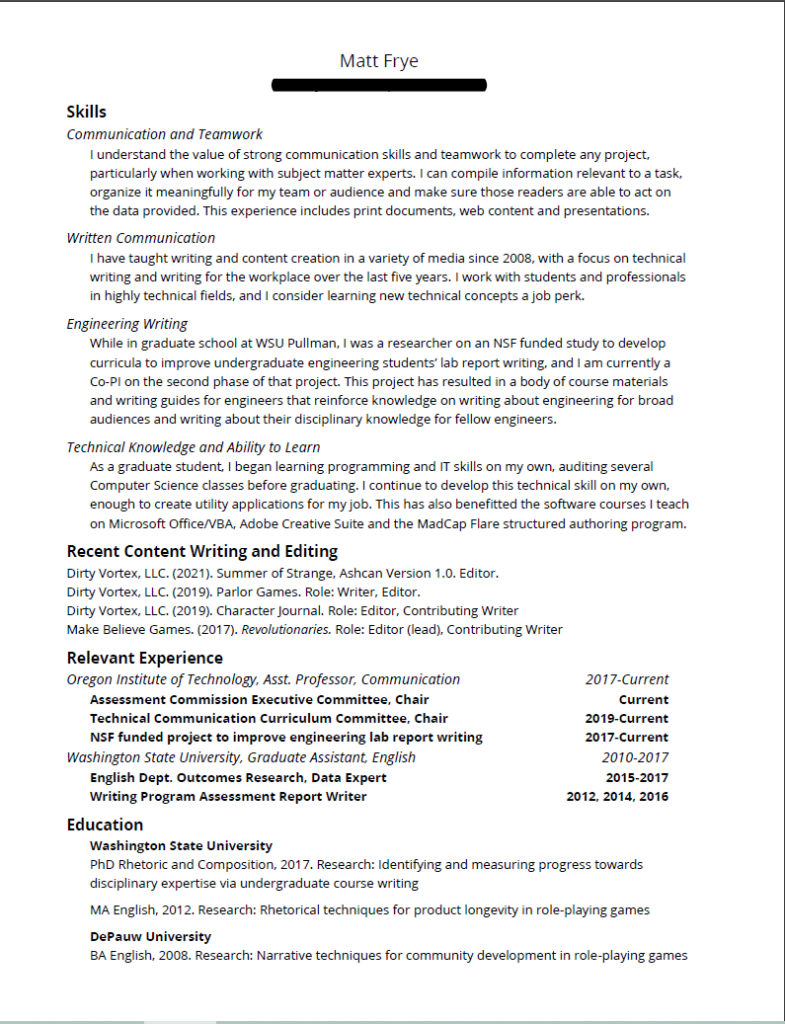
I understand the value of strong communication skills and teamwork to complete any project, particularly when working with subject matter experts. I can compile information relevant to a task, organize it meaningfully for my team or audience and make sure those readers are able to act on the data provided. This experience includes print documents, web content and presentations.
✔ Engineering Writing
While in graduate school at WSU Pullman, I was a researcher on an NSF funded study to develop curricula to improve undergraduate engineering students’ lab report writing, and I am currently a Co-PI on the second phase of that project. This project has resulted in a body of course materials and writing guides for engineers that reinforce knowledge on writing about engineering for broad audiences and writing about their disciplinary knowledge for fellow engineers.
✔ Technical Knowledge and Ability to Learn
As a graduate student, I began learning programming and IT skills on my own, auditing several Computer Science classes before graduating. I continue to develop this technical skill on my own, enough to create utility applications for my job. This has also benefitted the software courses I teach on Microsoft Office/VBA, Adobe Creative Suite and the MadCap Flare structured authoring program.
✔ Written Communication
I have taught writing and content creation in a variety of media since 2008, with a focus on technical writing and writing for the workplace over the last five years. I work with students and professionals in highly technical fields, and I consider learning new technical concepts a job perk.
[/su_spoiler]
[/su_accordion]
There is a lot of repetition in that list. Some days, I had a little more time and rage to spend really customizing the language for a resume. Other times, I didn’t have a lot of spare energy so I copied/pasted whatever blocks were relevant into a new resume (always with the file name “Frye – Resume – Position”).
These skill blocks took up half of the resume page. The other half included some pretty standard elements of a resume: relevant work, work experience, and education. There was some variation, but it typically looked like this:
Content Writing and Editing
Dirty Vortex, LLC. (2019). Parlor Games. Role: Writer, Editor.
Dirty Vortex, LLC. (2019). Character Journal. Role: Editor, Contributing Writer
Make Believe Games. (2017). Revolutionaries. Role: Editor (lead), Contributing Writer
Relevant Experience
Oregon Institute of Technology, Asst. Professor, Communication 2017-Current
Assessment Commission Executive Committee, Chair Current
Technical Communication Curriculum Committee, Chair 2019-Current
Assessment Coordinator, Communication Studies & Professional Writing 2017-Current
Washington State University, Graduate Assistant, English 2010-2017
English Dept. FYC Outcomes Research, Data Expert 2015-2017
Writing Program Assessment Report Writer 2012, 2014, 2016
Education
Washington State University
PhD Rhetoric and Composition, 2017. Research: Identifying and measuring progress towards disciplinary expertise via undergraduate course writing
MA English, 2012. Research: Rhetorical techniques for product longevity in role-playing games
DePauw University
BA English, 2008. Research: Narrative techniques for community development in role-playing games
I left my PhD on there. That was a lot of work, and it connected to the Graduate Assistant line above.
I also left my research interests in there for one big reason: my professional writing experience outside the academy was in creating role-playing game materials for small companies. This would become the foundation of my writing portfolio (separate post). I wanted to show that I put a lot of effort into understanding the material I produced, which did come up in every interview.
Cover Letter
When I did not have enough space in my one page resume to fit all of the skills I wanted to emphasize, I put one or two different ones or one or two different explanations into the cover letter. Not every application requires a cover letter, but I always wrote one and found a way to include it, even if it wasn’t going to be read. It was one additional opportunity to make a connection, and when I had the chance, I wanted to preemptively answer the “why are you quitting” question.
This is the cover letter I used for the job I ended up getting, with some minor redaction.
Standard opening paragraph. Current position, how I found the posting, and the connection I have to the post. I wanted to make sure they knew I was applying through their website instead of through LinkedIn or Indeed or anywhere else. That way, they’d know I sought them out to find the position, rather than scrolling through a list of job openings on a hiring site.
Dear Hiring Manager,
I am an Assistant Professor of Communication at Oregon Institute of Technology, and I am excited for the opportunity to apply for the open Writer position posted on the SEL website. After nearly a decade of teaching others to write short- and long-form technical documents, I find myself more frequently searching for freelance work or other opportunities to produce similar content myself, and the chance to make the shift to doing so full time is very appealing.
This one is a cheat. I was applying for a marketing writing position at an engineering company, so I would need to be able to work with subject matter experts without getting overwhelmed. However, Pullman, WA, is eastern Washington, out in the Palouse. I love it, and my wife and I set our hearts on me working at SEL because we wanted to return. But, like my Klamath Falls, OR, position, it’s common to get applicants who hear Washington and think “Seattle,” or who hear Oregon and think “Portland.” Pullman makes Spokane look like a big city! I needed to clarify that I was attracted to the work and the location.
I taught technical writing at the Pullman WSU campus from 2012 to 2017 and have continued to teach several general and specialized technical writing courses since being hired at OIT. These courses include getting students to work with subject-matter experts in their field to produce documents that are appropriate for general audiences or clients, as well as documents they would be expected to produce on the job. After teaching these courses for several years, I have developed professional relationships with popular experts, particularly engineering faculty, collaborating with them on small writing projects, getting advice to improve my teaching materials and even co-teaching an engineering senior project course this year.
I wanted to work in my ability to learn new things quickly enough to communicate their value. There were plenty of projects I could pick from, but SEL is an electrical engineering company, so I wanted to show that I could pick up the lingo.
I consider the opportunity to learn technical knowledge and skills from other disciplines a major job perk. I genuinely enjoy helping others find ways to communicate new and exciting knowledge to others. I recently had the opportunity to work with a Renewable Energy Engineering student on scoping a project for a Nevada state BLM grant to improve accessibility to BLM-owned grounds through the installation of pre-fabricated solar picnic table and enclosures. We worked over the summer to estimate and document additional traffic through day-use areas thanks to a relatively cheap but very recent implementation of solar panel improvements.
This was a risk, but it felt necessary to include. I was applying in early November, and I did not want to get into a position where I’d leave mid-term. As a rhetorician, I also knew that I wanted to put a limit on this offer to get a conversation moving quickly. If there was any hemming and hawing about calling me back, I wanted the reader to call me just in case I renewed my commitment to OIT. (I had a great series of interviews with another company that ran the entire summer of 2021 until they almost ghosted me. I wanted to make it clear that I wasn’t open to that.)
I am currently located in Klamath Falls, Oregon, and our Fall academic term does not conclude until mid-December. Our Winter term begins January 3, so I would need to make arrangements with my department quickly if given the opportunity to return to Pullman and work for SEL. I have experience working remotely with nationally- and globally-distributed teams if that is a temporary necessity during the transition period. I would enjoy talking to you more about this position, and I can be reached in the early morning by phone ([cell]) or anytime by email ([email]).
Sincerely,
[Signature]
The Final Resume
In the end, the resume below is the one that was successful. It isn’t perfect, but it started the conversation. It gave me plenty of things I could talk about in an interview: How would I interact with the writing team? Could I learn enough about power system protection and monitoring equipment to write persuasively about it? Would I get bored and want to go back to teaching?