

Two weeks in the bag! Feeling more confident, figuring out what my job looks like, and I even remembered to start bringing a lunch with me every day.
That last one sounds like a joke, but it isn’t. This is a college town, so the places I can run out to for a quick lunch are limited (not least of all because I’m fighting a campus-wide lunch rush).
Clocking In
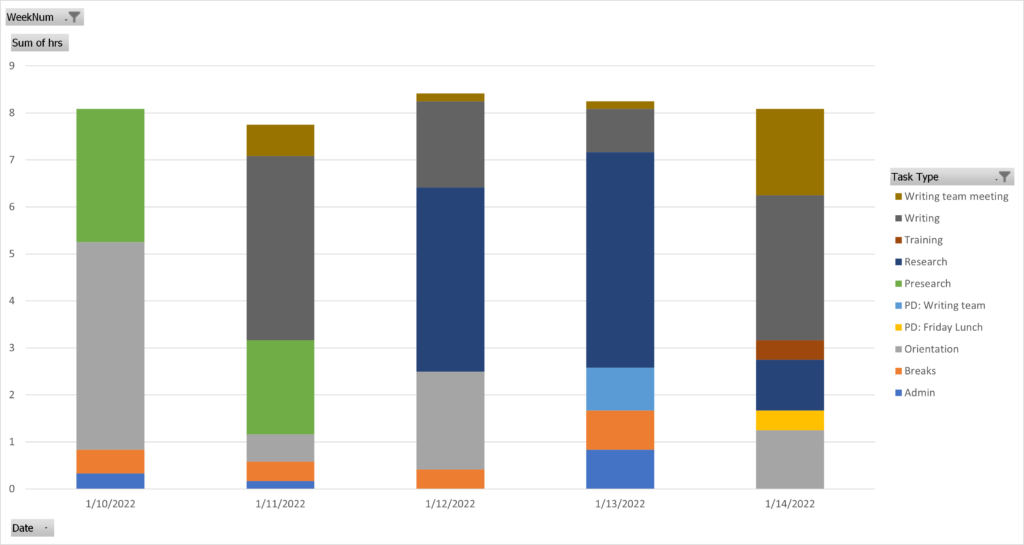
So, where’d the time go? Not to breaks, it seems — bringing my own lunch has shortened my lunch break. This week started a few tasks bigger than an email, so maybe it’s worth walking through each one. After all, this blog is partly my way of keeping tabs on where I spend my time and partly my way of explaining one version of what a professional writer does each day.
Orientation!
I mentioned last week that orientation here is a two week process, and that light-grey chunk of each day shows it. Tuesdays and Thursdays are “orientation on your own,” where we watch some video content and talk to our supervisors about specific processes — a portion of the orientation process goes through them, so they’re always checking up on processes and procedures as well.
I had heard that I might be getting a big project soon, so I decided to do all of the DIY orientation stuff on Monday to make room for the work. That might’ve been poorly planned, but we’ll find out. Either way, orientation is complete! I’m official! Last week, I was pretty happy with the way it was approached, and I still am now. I know there’s stuff I don’t know yet, but I also feel like the things I haven’t been told are just waiting until I have to know them.
Not in a bad way, like “Oh, we forgot to tell you that the system we use to submit grades times out sometimes, so you’ll actually want to submit them a day early.” More like “there’s no reason to walk through our time-tracking software because we don’t know if we’ll still be using it by the time you work on one of the projects it tracks.”
After learning Angel pretty thoroughly for a year before my grad program switched to Blackboard, then mastering my next school’s implementation of Blackboard right before it switched to Canvas, I’m pretty happy about this.
(P)Research
In comp classes, we talk about the research at the very start of a project — the information you gather so you know what kind of information you’ll need to gather later on — presearch. Clever, right? Well, I took that approach here when I was told about a project I might be taking on at… some point. No one is quite sure when it’s going to happen because it depends on a few other things falling into place.
It sounds vague, but the broad topic area is one that I’ll engage with plenty in the future, and it’s not like academia doesn’t have this same thing. (“Hey, we might need you to teach a class on [subject or process you taught for one unit several years ago]. Just a heads up. Nothing certain yet.”)
So, I spent about 15 hours this week scouring the company website, Google Scholar, the YouTubes and competitors’ websites just trying to wrap my brain around a thing that, honestly, I didn’t know about before this week. It turns out, a big part of writing professionally is reading professionally.
Writing
I don’t have an official project yet, but it’s hard to sit still. In academia, you’re always grading, prepping for classes, putting materials together for courses next term, writing reports… There’s always something that needs to be done.
As a grad student, I developed a pretty simple philosophy of productivity: I wouldn’t do a task unless it was actually three tasks in a trenchcoat. Grading was also prepping upcoming class sessions (as in, “let’s talk about what we wrote”), but it was also prepping courses for next term (as in, “what did the prereq course need to cover better? and what can I do in the follow-up course to take advantage of what they’re doing in these projects?”).
Reading? Course prep and presearch into unfamiliar subjects (or research into discourses I needed to do more work on).
Playing video games? Potential assignment design ideas and reconnaissance into the ways other people planned and executed stories/designs.
This week, as I read, I wrote summary content to connect ideas together and generate potential copy for the project I might do in the future. I compared my language to what I saw on the screen. When I ran into roadblocks, I used that as a signal to read up on a concept a little more.
Writing those little bits here and there got about 9 hours of my week.
Breaks
One of the reasons I left teaching was that I never felt like I had time off unless I was stealing it. (Playing video games with my wife usually followed the phrase “Just for a little bit, because I need to get X graded tonight.”) Taking breaks is hard. I used to eat lunch at my desk to get more work done, and my days were otherwise scheduled back to back to back, so there wasn’t a lot of time to stop. It got even worse when everything went to Zoom, suddenly your meeting could run over into that 5-10 minute window people usually needed to get to their next thing. I wasn’t shocked to find out that those few minutes were invaluable for switching my brain into the gear necessary for the next task, but I was shocked to find out exactly how hard it was to Do A Thing if you never had a chance to change gears.
So, there’s not a lot of break time here. Washington allows for a 15-minute paid break every 4 hours and a 1-hour unpaid lunch every 8. I should have an hour and a half of orange up there every day. Let’s consider that a goal going forward.

One thought on “What *Should* I Do Here?”