
We’ve spent the last few weeks talking through rhetorical appeals and processes more deeply, with an eye towards convincing someone to act when they had no idea you were about to reach out to them. We’ll put those principles into practice by writing an unsolicited proposal to our target audience—something delivered or encountered with no prior warning, where our rhetorical task is to convince them to act when they weren’t planning to do so in the first place.
These proposals typically take the form of letters, though they could also be web pages (like crowdfunding pages), social media campaigns (typically a series of posts, rather than a single bit of outreach) or other kinds of outreach. Again, as with the solicited proposal, I don’t want to put a constraint on what you produce just to standardize what I’m grading. Instead, I’ll be grading your annotations explaining your rhetorical choices and the effectiveness of those choices overall. If there is some content that you are not able to provide right now, but you feel that you could provide by the end of the term, please craft placeholder content and leave a comment explaining why it will be effective.
By the end of the term, I will expect you to fill in all or nearly all of those placeholders, but you don’t need to exhaust yourself doing that right now.
Deliverable
In a Word or Open Office document, please compose the following. Use the Page Break tool to ensure each component starts at the top of the next page.
- A cover page with your name, your project name and a brief description of what you’re asking for support for (2-4 sentences).
- A separate page with your last discussion post (the table of dispositions) copied and pasted.
- Your proposal draft, with annotations and placeholders.
- Annotations should at the very least identify your Territory, Gap, Goal and Means
- Annotations should also identify the places where you generate the dispositions from your table
Annotations
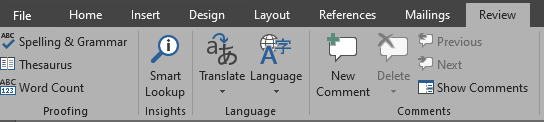
In Word, you can add comments by heading to the Review tab, then clicking New Comment.
Peer Review
By Wednesday May 26, please post your draft to the Unsolicited Proposal Discussion board as an attachment. By Friday May 28, please respond to two of your peers’ proposals. You should respond to the post directly above and directly below yours. (First and last posters: pick any peer for the above/below post. If you do not submit a document for review, you may pick any two peers to review.)
You will receive 2.5 points each (to a max of 5 points) for reviews that address the following:
- Is the proposal’s project clear, in the proposal draft itself? If not, where could it be improved or what did it seem like the project was?
- Does your peer use each rhetorical move appropriately and effectively? If not, which ones could be improved?
Proposal Grading
As noted on the syllabus, there is a due date but not late penalty on this. Please submit this document by Sunday May 30, or as soon as you are able to. A woefully incomplete proposal is better than nothing! Note that the rubric below is intentionally very forgiving. I’m hoping that you’ll do revisions over the next five weeks.
- Territory, Gap, Goal, Means: 3 points possible
- Identifying all four of the moves described by Connor and Upton is worth 3 points
- Dispositions: 5 points possible
- Identifying all of the dispositions from your table is worth 2 points.
- Using the right evidence or discussion to create all of those dispositions is worth 2 points.
- Clumsy or incorrect rhetoric is worth 1 point.
- Ending with the right disposition for the action you want your audience to take is worth 1 point.
- Formatting: 1 points possible
- Formatting your document in such a way that it is easy to read and matches the type of document it is meant to be (e.g. letter, social media post, webpage) is worth 1 point.
- Correctness: 1 points possible
- Having no errors or stylistic mistakes the average reader would notice is worth 1 point
