At least part of my academic life (5-10% by contract, but plenty more in reality) was academic assessment. I spent a lot of my research life trying to find the best ways to measure whether or not students were meeting objectives, particularly through writing they produced.
It’s like quality control. If the data collected suggests that objectives are being met (whether that’s students meeting course objectives or a program meeting its objectives), then everything’s good. If something measures up below expectations, then the goal of assessment is to find ways to meet them.
It worked out nicely that I ended up at a place that values that mindset, but I’ll save that for another post.
This post is about work life balance and whether or not it’s better outside academia. YMMV, but the quick answer is a simple, resounding yes.
What do I do on Monday?
When I was interviewing, the main question I wanted an answer to was what the job looked like day to day. I’d been teaching for over a decade at that point. I could imagine the day-to-day life on any college or university campus and how I’d get my work done. You could say, “Hey Matt, we had a change of plans and you actually need to start teaching a class on [something] next week,” and I’d spend the weekend putting together a syllabus and learning objectives.
Crucially, I knew that academic work meant working nights and weekends (the joke at my last school was that nights and weekends were for doing the work you were too busy to do during the workday, because it was full of too much work already). What were the processes going to be when I was a full-time writer?
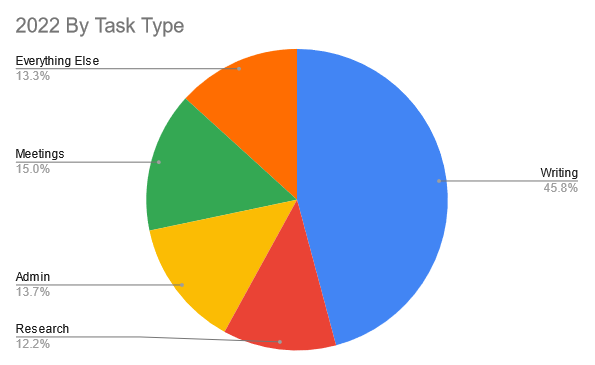
Thankfully, I used to be an assessment guy. Planning measurements, keeping data, and figuring out what to do with that data was something I was prepared for. Between January 3, 2022, and December 30, 2022, I logged every work-related task in a time diary. 3107 separate events over 238 workdays.
Reading, Writing, Administration
As a marketing content writer, half of my time was spent writing (safe assumption). About a quarter of my time was spent getting background information for my writing or projects I was working on (Research + Meeting time). The last quarter was spent between miscellaneous stuff (orientation, trainings) and project management and maintenance (making sure people received drafts, updating content as reviews came in).
I wouldn’t have guessed that would be the case last January. Specifically, I wouldn’t have imagined that a non-managerial content-creation position would involve so much project management. Some projects can get pretty involved, and I like being in the loop about where draft copy is going and how it’s getting received.
But what do you write?
I’ve written (either from conception to publishing or just revising and republishing existing material) webpage content, emails, product flyers, social posts, print materials, and video scripts, pretty much the full range of things this writing group produces. I’m not waiting to unlock anything—the only things I haven’t gotten to publication are some customer experience highlights, and that’s just because they take a lot of time.
Top 3 types of documents by hours: web content (~300 hours), emails (~200 hours), and flyers (~100 hours).
Top 3 by number of things produced: emails (~100 emails), web content (~70 pages), and flyers (~20).
After years of joking that being a professor was 50% email management and 50% miscellaneous tasks, I ended up in kind of the same situation. The difference here is volume: I’d answer 40-50 emails every day when I was teaching, plus a few class-wide email blasts each week. Now, I spend 2-3 hours per email researching the content and audience and crafting a solid message in about 80 words. Upside: I get performance metrics on those emails to see if they do the thing they’re supposed to.
Similarly, I’d spend hours each week updating web content as a teacher: Canvas/Blackboard pages or WordPress sites that housed course information. Now, I spend time researching the product, solution, or service that a webpage is supposed to promote, and I craft the text of a document to emphasize those points. Upside: I get half a dozen reviewers to check the thing over and make sure I didn’t forget anything.
Product flyers seemed like they’d be the unfamiliar thing in the set. But, you know what a product flyer is? It’s a summarized (4-, 8-, or 12-page) version of a product datasheet (typically 50-100 pages), emphasizing key features and use-cases. You know what else is an ultra-high-level summary of key benefits and uses? A syllabus.
Where’s the balance?
I’m highlighting time spent and stuff produced as my primary assessment measurements for work life balance because that’s where the balance falls apart in academia. There’s always tons of stuff to produce and not enough time to produce it.
I have produced a lot of stuff in the last year. Almost 200 separate things bound for external readers (for anyone about to scroll up to those opening numbers, that’s about one thing per day, ranging from 200 character social media posts to 16-page product flyers). But, I left out a key number from the intro that emphasizes balance.
I logged 1936 work hours, including lunches and breaks. Again, for those about to do some quick math, a 40-hour work-week split over 52 weeks is 2080 hours. Let’s compare that to the ol’ academic gig, since there was always a worry that I’d be just as overworked (if not more) in an environment where I didn’t get summer or Christmas or spring break. But, quick back of the envelope math is probably going to be helpful.
Academic Term
Total Weeks
Breaks
Hours
September through May
36 weeks
Winter (2 weeks), Spring (1 week)
@40/week: 1320
June through August
12 weeks
Ha.
@20/week: 240
48 weeks
Minus 3
1560 hours
Wishful thinking
1560 hours over about 45 weeks, but that assumes the regular academic term is actually 40 hours a week and the summer contract is actually 20 hours a week and that academic breaks are actually breaks and not a regular workweek preparing for the next term. Add in 2-3 hours per weeknight and 8 hours each weekend during each of those terms.
Academic Term
Total Weeks
Breaks
Hours
September through May
36 weeks
Winter (2 weeks), Spring (1 week)
@60/week: 2400
June through August
12 weeks
Ha.
@40/week: 480
48 weeks
Minus 3
2880 hours
More realistic
So, I’ve landed in the middle range of working hours, in between what we think an academic job should be (nevermind that I’m assuming summer teaching is mandatory) and what it usually turns out to be. In the meantime, I’m doing roughly the same kind of work, but when I goof a webpage or an email, I get a couple of people asking for a revision instead of 20 people emailing me at all hours to fix or explain it.
I work fewer hours overall, that’s good for balance.
My hours are more predictable. I’m in around 8:30am every day, and I’m done around 4:30.
My hours are mine. I’m trusted to get my work done pretty autonomously in those hours. If I take a day off (planned or not), I’m trusted to get things done within the normal workday, not move the “lost” day into the weekend or evenings.
My work is reviewed. It gets several sets of eyes before it goes out into the world, and when it comes back for revision (it usually does), the notes are low-key: please add a note about this feature, please use this technical phrase, consider breaking this big paragraph up.
Fewer hours, lower stress, and more predictability. That’s pretty good for balance. Oh, and that 40% base pay increase for switching jobs was pretty nice, but that’s for another post.
I started my job in marketing content writing at SEL on January 1, 2022, transferring out of academia and into industry. I spent over a decade teaching different kinds of writing and content production: academic writing, technical writing, science writing, video and graphic production, writing and design for the web, a whole pile of stuff.
It’s a big change in the profession I report to the IRS (teacher to writer), and there were some big mental changes to go through in the process. But, really, the shift was from teaching others to do a thing to doing that thing myself. I wouldn’t even say that the shift was from teaching to doing generally, because the skills I used to persuade students that some process or tool was the most effective for their project are the skills I use now to write about products and technologies.
So, what are the big takeaways from this year? The key to good blogging is to be succinct and break big things into smaller chunks (gotta get more clicks somehow), so here’s a preview of what’s coming from this thread:
Did I solve my work/life balance problems? Hell yes, I did.
Does academic work prepare you for industry? In ways I would not have expected.
What does a content writer write? Everything. Nothing.
How important was peer review, really? Very, but not for the reasons we say out loud.