Discussion 2: Audience Analysis

During this week, please do the following.

  • Step 1: By Wednesday, please either (a) return to your post from last week, (b) post a new RFP that caught your attention or (c) adopt a peer’s RFP. At the bottom of that thread, please state that you’re going to use this RFP for your Solicited Proposal.
  • Step 2: By Friday, please respond to your post from Wednesday, addressing the questions below. If you and a peer (or several peers) are responding to the same RFP, each person after the first should suggest a project that this audience would value and explain why they would value it. (You are contributing to a group brainstorm for a solicited proposal.)
    • What organization, individual or group provides the funding or other support behind this RFP?
    • What does this organization, individual or group value, and how would a project in response to this RFP support those values?
    • What kinds of projects has this group supported in the past?

Process

Please note that I intentionally weight discussion boards towards simple participation, rather than making some number of discussion points. I want you to engage with each other, but I don’t want to force it. To that end, our course discussion board is going to be … weird.

Whenever you post, please write at the top of your post “Discussion X-Y,” where X is the discussion number and Y is the step number (1 or 2). That’s what I’ll use as a signal for which assignment you’re doing, if any (or if you’re just responding to a peer for funsies).

This is going to make a pretty giant mess when it comes to grading, so I’ll try to give feedback as quickly as possible, but getting the points in the book will be another matter entirely.

Grading

Discussion boards in this class are all worth 5 points. The first post is worth 2, and it is graded on whether or not it was completed on time. The second post is worth 3 points, split between the quality of your response and the timeliness of it.

Step 1: You’ll get 2 points if you post your initial note example by Wednesday night. (Obligatory wiggle room statement: I’ll start checking Thursday morning, but your peers might be looking sooner.)

Step 2: You’ll get 2 points if you cover all three items (organization, values, past projects) in your response, and if your response is up by Friday night. You get 1 point just for attempting this step.

Discussion 1: Move Identification

During this week, please do the following.

  • Step 1: By Wednesday, please post a link to an RFP for some course of action or issue you want to support. (Test your link! If you cannot provide a direct link, please provide a PDF or other copy.) Please say what kind of support this grant provides.
    • Financial: Many grants are for cash, which a grant project manager then decides how to spend.
    • Material: Some grants offer material support primarily, typically in the form of software/equipment or cash dedicated specifically towards equipment or material.
    • Information: Some request documents are RFIs, requests for information, which will require some specific research skill on your part.

      If you are using Grants.Gov, you can paste the opportunity number (let us know that’s what it is), or look for the “Link” option in the top-right corner of the page.
Shout out to Trevor for pointing this out.

  • Step 2: By Friday, please respond to the person above you (the first poster gets to respond to anyone). Identify the following in the proposal they posted.
    • Territory: What is the domain or type of problem that this proposal is set in?
    • Gap: What is the problem that needs to be solved?
    • Goal: What is the solution to the problem?
    • Means: How is the problem solved? Or, how will it be solved if the audience acts?

Process

Please note that I intentionally weight discussion boards towards simple participation, rather than making some number of discussion points. I want you to engage with each other, but I don’t want to force it. To that end, our course discussion board is going to be … weird.

Whenever you post, please write at the top of your post “Discussion X-Y,” where X is the discussion number and Y is the step number (1 or 2). That’s what I’ll use as a signal for which assignment you’re doing, if any (or if you’re just responding to a peer for funsies).

This is going to make a pretty giant mess when it comes to grading, so I’ll try to give feedback as quickly as possible, but getting the points in the book will be another matter entirely.

Grading

Discussion boards in this class are all worth 5 points. The first post is worth 2, and it is graded on whether or not it was completed on time. The second post is worth 3 points, split between the quality of your response and the timeliness of it.

Step 1: You’ll get 2 points if you post your initial proposal example by Wednesday night. (Obligatory wiggle room statement: I’ll start checking Thursday morning, but your peers might be looking sooner.)

Step 2: You’ll get 2 points if you cover all four items (Territory, Gap, Goal, Means) in your response, and if your response is up by Friday night. You get 1 point just for attempting this step.

Annotated Resume or Biosketch

In this assignment, you’ll create a specialized resume called a biosketch or annotate your current resume to identify your areas of specialized knowledge. It’s up to you which one you decide to do. A brief description of each option is below.

The purpose of this document is to provide a starting point for our Solicited Proposal project. If you are responding to a RFP that wants a biosketch, then awesome! You’re set. If your audience doesn’t require one, you will have material ready to drop into your discussion.

The turnaround on this assignment is intentionally short. I need time to provide feedback to you before we get into the Solicited Proposal assignment. At the end of the term, the final project will ask you to submit this document again, and you’re free to revise it before then.

Biosketch

A biosketch is a special type of resume often submitted along with large-scale research and development grant proposals. Instead of a work history, this document shows your specific set of expertises. It is meant to demonstrate that you can get certain kinds of projects done. While not every grant or funding opportunity requires a document like this, all will want to know your competencies and track record in a particular field. Having this document on hand makes it easier to include that material in a written proposal later on. You can read more about it at this link, and you can use this template to create one.

As students, we likely don’t have information for all of these sections, and that’s fine. If you choose to do one, the larger purpose here is to think about the specific kind of academic/professional training we’ve had and the projects we’ve completed (school projects or otherwise), and try to connect those to grant/funding opportunities as the course goes on.

  • Your professional preparation typically covers academic coursework and very general training. It’s similar to the Education section of a resume. 
  • Your appointments section is not equivalent to work history. This section should cover any long-running jobs where you’ve applied your specialized knowledge or expertise. These should be things where you’ve performed a variety of tasks that are relevant to your specialty, but not tied up with a single project. Specific courses are acceptable to note here.
  • Your Products section is where you should note any major projects you have applied your expertise to. These should be things that culminated in one product or outcome. They can be related to your appointments.
  • The synergistic activities section is a little more challenging. This should list any groups that you are a member of, organizations that you support or other activities you engage in that are related to your expertise but that don’t fall into the categories above.
  • The collaborators and affiliates section is like the References document you submit alongside a resume. The main reason you list these people on a biosketch is to indicate potential connections you could draw upon in a project that stems from your expertise. So, only put people that are connected to your expertise!

This document is expected to be about a page long.

On the next page, please include one paragraph describing what kinds of projects you want to be involved in as a grant writer.

Annotated Resume

If a biosketch doesn’t sound useful to you, you can also create an annotated resume. You can use a resume you’ve already created, or you can craft one specifically for this assignment. (If you’ve never made a resume before, see this link and drop by Thursday’s class for some advice.) The catch is that you need to add annotations to explain the following:

  • What elements of your resume clearly demonstrate your academic expertise(s)? They must explicitly demonstrate it—if you have to explain that your BS in Mechanical Engineering means you’re an expert in rocket propulsion, you might need to make it more clear in the resume itself.
  • What elements of your resume clearly demonstrate professional or technical expertise? Again, if your annotations have to explain something, try to find a way to make it more explicit in your resume.

Annotations should be added using the Comment tool of your word processor. In Word, the Comment tool is under the Review tab. In Open Office Writer, the Comment tool is under the Insert menu.

This document should not be more than a page long.

On the next page, please include one paragraph describing what kinds of projects you want to be involved in as a grant writer.

Process

Please complete this document and submit it on the Biosketch assignment on Canvas (LINK) by Sunday, April 4.

Grading

This rubric is pretty simple — either this document clearly shows where your expertise is at or it doesn’t. If your written feedback is minimal, this is either because (a) your work was excellent and I can’t recommend much or anything for improvement or (b) your work indicates that you did not spend much time on this assignment.

  • Basic Information (3 points possible)
    • 3 points: Document clearly notes who you are, your major/academic background and other technical or professional expertises (if any)
    • 1 point: Document clearly notes who you are
  • Identifying Details (3 points possible)
    • 3 points: Your document has clear details connecting you to specific expertises or types of projects.
    • 1 point: Your annotations have to explain your connection to specific expertises or types of projects.
  • Suggested Application (4 points possible)
    • 4 points: Your paragraph clearly indicates the types of projects you would be interested in.
    • 2 points: Your paragraph indicates vague areas you would be interested in working.

WRI 410: Syllabus

Instructor and Course Info

Matt Frye — matt.frye@oit.edu — 94I-5O4-I38O

Office Hours: Noon – 12:50pm Daily (All classes) // 3:00pm – 4:20pm T/R (see below)

WRI 410 focuses on the process of writing a proposal-style document, and it is geared specifically towards grant proposal writing and fundraising. Many of the discussions in this class are applicable for research project proposals, business proposals and crowd-funding campaigns. This course uses a combination of corpus linguistics, genre analysis and rhetorical analysis to create a set of disciplinary rules for crafting a proposal. By the end of the course, you are expected to create a proposal of your own that is appropriate for submission to its target audience—whether that be a major funding source like the National Science Foundation or a local interest group like a book club.

Due to COVID restrictions and the fact that I’m teaching an online WRI 410 and an “on-campus” WRI 410, the structure of this class will be a little odd. I’ll post lecture/overview videos each week, and I’ll ask you to engage with your peers via discussion boards. Our class time (3:00pm – 4:20pm, Tuesdays and Thursdays) will be set aside as a special set of office hours just for Grant Writing students. On Tuesday, we’ll do a general Q&A and discussion of readings and assignments. On Thursday, we’ll do a more practical look at how our readings work with real-life proposals. Attendance is not required for these sessions. As per OIT policy, these sessions will be recorded and posted to Canvas.

Learning Outcomes and Objectives

By the end of this course, you are expected to be able to do the following:

  • Describe the genre conventions of RFPs (or similar documents) and proposals, both generally and within your discipline or career path
  • Locate RFPs (or similar documents) appropriate to your discipline and career path
  • Analyze the audience of your work using both RFP information and external research
  • Clearly explain the purpose of your work to your audience
  • Fully describe your audience and their needs/expectations
  • Make appropriate adjustments to documents to meet the needs of your audience
  • Use appropriate evidence/support to demonstrate your expertise to your audience
  • Generate and work within your own schedule to meet the needs of an external deadline
  • Assess and justify your own decisions in every document you create. (I can grade you for the next 10 weeks, but starting in week 11, you need to do that for yourself.)

Assignments and Grades

There are four major units in the course, each supported by a series of discussion boards. For ease of math, all assignments are entered into Canvas at their final gradebook value. If you ever want to know your current grade, just add up the total number of points you’ve received. (See Late Policy below.)

Unit 1: Getting to Know You (10%)

Annotated Resume or Biosketch: 10%

Unit 2: Solicited Proposal (35%)

Discussion 1: Move Identification: 5%

Discussion 2: Audience Analysis: 5%

Discussion 3: Move Planning: 5%

Annotated Proposal Draft: 15%

Peer Review: 2 @ 2.5% each

Unit 3: Unsolicited Proposal (35%)

Discussion 4: Audience Identification: 5%

Discussion 5: Core Appeals: 5%

Discussion 6: Buddy System: 5%

Annotated Proposal Draft: 15%

Peer Review: 2 @ 2.5% each

Unit 4: Finalized Proposal (20%)

Revised Resume or Biosketch: 5%

Annotated Proposal: 15%

Course Materials

All course materials will be made available online. I recommend using Microsoft Word (which you can get with your OIT login info at Office.com) or Open Office Writer (which you can get at OpenOffice.org). Please do not use Google Docs to create your documents for this class. Document formatting in grant proposals is very important, and Google Docs doesn’t offer a lot of power in that area.

Policies

Attendance

As noted above, I’ll be using our class time as a sort of focused office hours just for grant writing students. Tuesdays will be general Q&A, while Thursdays will include a practical walkthrough or use-case of our readings or assignments for that week.

Academic Honesty

According to OIT-14-030 (Student Academic Integrity policy): 

Academic dishonesty is defined as cheating, plagiarism or otherwise obtaining grades under false pretenses. Plagiarism is defined as submitting the language, ideas, thoughts or work of another as one’s own or assisting in the act of plagiarism by allowing one’s work to be used in this fashion. Cheating is defined as, but not limited to: obtaining or providing unauthorized information during an examination through verbal, visual or unauthorized use of books, notes, text and other materials; obtaining or providing unauthorized information concerning all or part of an examination prior to that examination; taking an examination for another student or arranging for another person to take an exam in one’s place; altering test answers after submittal for grading; changing grades after grades have been awarded; or altering other official academic records.

You will use materials created by other people and organizations to do your work. I expect you to incorporate the thoughts and language of others into your work, but we will also discuss the ways of documenting this appropriately. The important qualities to pay attention to are “appropriate” and “authorized.”

While attribution style will differ according to your discipline and career path, the rhetorical move of showing what conversations you are connected to is an absolute necessity. No professional works in isolation.

Intentional plagiarism or outright cheating will result in a zero on the task. Egregious or repeated offenses will result in a referral to the Student Hearing Commission.

Classroom Conduct

On discussion boards, you are expected to act like professional. Please contribute to discussions and activities, and do not purposefully harass, intimidate, insult, bully or otherwise diminish the experience of any of your peers.

In the age of social media, this also goes for conduct outside class, but I’m not grading that.

Email/Communication

No working relationship should be completely inflexible. Any policy in this syllabus or on any assignment is up for discussion, individually or class-wide. If life throws you a curveball and you need some wiggle room, let me know. If an assignment just isn’t working for the class, we can change it. I plan these classes long before the term starts, and something is bound to need adjustment as the quarter unfolds.

I do my best to return emails as quickly as possible, but I’m old and I keep old-people hours. Please give me 24 hours to get back to emails. If it’s more urgent than that, I welcome texts and calls to the phone number at the top of the syllabus (it’s my cell, so it should stay active if Skype for Business goes down).

Accommodation

If you have a disability that requires any additional accommodations to complete work this course, please let me know. Like all professors at OIT, I rely on the Disabilities Service Office in LRC 229 to help me with this process. If you feel that you may need some accommodation in your courses, please contact this office.

In an online setting, that requirement is particularly onerous. I’m happy to make any and all accommodations necessary to help you reach our course objectives.

If you do not have a disability but you think I could do a better job of accommodating your learning style, also let me know. Seriously. I do my best to ensure that my courses create as few hurdles as possible beyond their content. If I’m not succeeding there, I want to know.

Late Policy

In the world of grant writing, there is no late policy. Anything received after a deadline (even moments after a deadline) is typically unacceptable. This is just due to the nature of grant writing: any opportunity is going to be met with dozens, hundreds or even thousands of proposals. Any restriction that a funding group can place to filter out proposals is just a matter of workload control. Please use our planning assignments to your advantage to make sure that you stay on schedule!

… Now, that said, this is a college course. I hope you’re writing these proposals for a real purpose. However, I completely, totally, 100% understand that life is going to get in the way for all of us at some point this term. That’s just due to the nature of being in college: mine is just one of four or five courses you’re taking right now.

Discussion boards can be completed late, but your posts are only worth 1 point. Proposals can be completed late at no penalty. The only hard deadline is the end of the term, as I need to have grades in by the Monday after finals week.

WRI 410: Grant and Proposal Writing

Welcome to Grant and Proposal Writing! This page has the schedule and links to all of the resources you need for the course. All of this content is duplicated on Canvas.

Schedule

Week 1 (March 29 – April 2)

Videos

Readings

  • Biosketch Guide: LINK
  • Biosketch Template: LINK
  • Resume Guide: LINK
  • RFP Resources: LINK

Assignments and Due Dates

By the end of the week, please complete the Annotated Resume or Biosketch assignment. Also, drop by the Main Discussion board and introduce yourself!

Week 2 (April 5 – 9)

Videos and Readings

  • Weekly Overview video here: LINK
  • Connor and Upton Walkthrough here: LINK
  • Discussion Post Assignment Overview here: LINK

Ulla Connor and John Upton’s “The Genre of Grant Proposals,” from Discourse in the Professions: LINK

Assignments and Due Dates

We are officially starting the Solicited Proposal project this week. It is due on May 2.

By Wednesday, complete step 1 of Discussion 1. By Friday, complete step 2.

Week 3 (April 12 – 16)

Videos and Readings

  • Weekly Overview video here: LINK
  • Weekly Discussion Board video here: LINK
  • Solicited Proposal video here: LINK

Module 15 of Lumen Learning’s Technical Writing: LINK to table of contents, or individual readings linked below.

Assignments and Due Dates

By Wednesday, complete step 1 of Discussion 2. By Friday, complete step 2.

Week 4 (April 19 – 23)

Videos and Readings

  • Week 4 Overview: LINK
  • Discussion 3 Overview: LINK
  • Readings Overview: LINK
  • Word Techniques for Page Design: LINK

The overview, the discussion board explanation, the readings explanation and a Word Processor Techniques video to go with our readings. I recorded them Sunday afternoon, but the sunlight makes them difficult to watch (which is a nice way of saying I’ve spent far too much time indoors the last few months). They’ll be re-done and posted by noon on Monday.

Module 3 of Lumen Learning’s Technical Writing: LINK to table of contents, or individual readings linked below.

Assignments and Due Dates

By Wednesday, complete step 1 of Discussion 3. By Friday, complete step 2.

Week 5 (April 26 – 30)

Videos and Readings

Overview video for this week: LINK

No additional reading.

Assignments and Due Dates

By Wednesday, please post a rough draft of your Solicited Proposal to the Solicited Proposal Peer Review discussion board. By Friday, please review two peers (the person who posted above you and the person who posted below you).

By Sunday, please submit your Solicited Proposal to the assignment page on Canvas.

Week 6 (May 3 – 7)

Videos and Readings

  • Overview video: LINK
  • Connor and Gladkov video: LINK
  • Discussion video: LINK
  • Unsolicited Proposal: LINK
  • What do we do about last week? LINK

Ulla Connor and Kostya Gladkov’s “Rhetorical Appeals in Fundraising Direct Mail Letters,” from Discourse in the Professions: LINK

Assignments and Due Dates

We are starting the Unsolicited Proposal this week. It is due May 30.

By Wednesday, complete step 1 of Discussion 4. By Friday, complete step 2.

Week 7 (May 10 – 14)

Videos and Readings

Videos

  • Weekly overview: LINK
  • Rhetoric overview: LINK

The videos below are from last year. I started to re-record things for this year, and I realized that I was just repeating myself. I don’t like to re-use old stuff like this, but it’s the best I can do at the moment! I recommend either reading the Aristotle chunk or viewing the videos.

  • Book 2, pts. 2-3, Anger/Calmness: LINK
  • Book 2, pt. 4, Friendship/Enmity: LINK
  • Book 2, pts. 5-6, Fear/Confidence, Shame/Shamelessness (Pride): LINK
  • Book 2, pt. 7, Kindness/Unkindness: LINK
  • Book 2, pt. 8, Pity: LINK
  • Book 2, pts. 9-11, Envy, Emulation and Indignation: LINK
  • Book 2, pts. 12-14, Audience Types: LINK

Aristotle, Rhetoric. Please just read Book II (pages 38-77): LINK. If you need a cheat sheet for the dispositions, try this one.

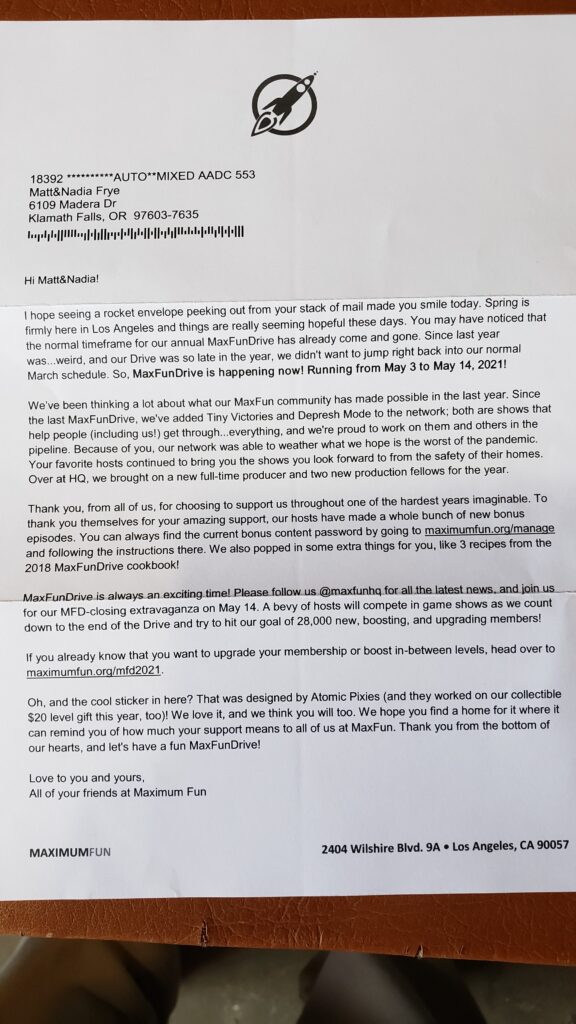
And, here’s that Maximum Fun letter:

Assignments and Due Dates

By Wednesday, complete step 1 of Discussion 5. By Friday, complete step 2.

Week 8 (May 17 – 21)

Videos and Readings

Week 8 Overview: LINK

Discussion Board Overview: LINK

Goering Video: LINK

Elizabeth Goering’s “Framing Matters: Communicating Relationships through Metaphor in Fundraising Texts,” from Discourse in the Professions: LINK

Assignments and Due Dates

By Wednesday, complete step 1 of Discussion 6. By Friday, complete step 2.

Week 9 (May 24 – 28)

Videos and Readings

Overview video here.

No additional readings this week.

Assignments and Due Dates

By Wednesday, please post a rough draft of your Unsolicited Proposal to the Unsolicited Proposal Peer Review discussion board. By Friday, please review two peers (the person who posted above you and the person who posted below you).

By Sunday, please submit your Unsolicited Proposal to the assignment page on Canvas.

Week 10 (May 31 – June 4)

Videos and Readings

Week 10 video link

Assignments and Due Dates

If you complete some revisions by Wednesday, please post your materials to the Final Project discussion board. Follow our normal peer review procedure (reviewing the person above you and below you) by Friday to get 1 point of extra credit per review.

Finals Week

Your final project materials are all due by Wednesday night. (I’ll start grading on Thursday.)

css.php