Do You Even Write, Bro?

One of the reasons I stopped teaching was time. I’ve mentioned it in plenty of other posts by this point, including a few longer posts that haven’t gone live at the time I’m writing this. I didn’t have time to spend with my family, which was bad for everyone. I didn’t have time to tackle little household tasks, like cleaning, or bigger household tasks, like maintenance. That was also bad for everyone, but especially my spouse, who felt like she needed to take a lot on while also taking care of the kids when I was gone all day and unavailable on the weekends.

I also didn’t have time to do things I enjoyed, which was bad for me. I’ve written about cool freelance projects I’ve gotten to do, but those were usually done late at night, after everyone else had gone to bed. Having to choose between sleep and personal time isn’t great, but it’s what a lot of us—not just teachers—end up doing. I mean, we’ve all seen that article about “revenge bedtime procrastination” floating around the internet, right?

Fun fact: While I was tracking down a link to that article, I saw that the line of thought didn’t stop at a NYT clickbait piece (pro-tip from someone who taught research writing for ages: major news outlets are never the last word on something, and they’re usually a few months or years behind the most recent word on something). Since that was published, the idea of “ubichronic” time has started getting more attention, while the literature on procrastination continues to grow. Insert joke here questioning what those researchers were avoiding by doing that lit review.

But after two months of living in Idaho and working in Washington while my family is down in Oregon until we find a place to live up here, it’s worth taking a moment to ask if I’ve solved my time problem.

Josh Gondelman on Twitter: ""But there was time! There was finally time!" -  Cruz and Rubio as Trump clinches this Twilight Zone episode of a  nomination" / Twitter

There Is Finally Time…

So, I do have more personal time. That’s an easy answer to get out of the way immediately. I’m still commuting two hours of every workday, but every once in a while an I get an errant reminder from my old work calendar that made its way onto my personal calendar. Those little reminders are enough to tell me that I might be walking in the door at 6pm, but the rest of the day is all mine. (And, an hour to check out my most recent Bandcamp purchase isn’t half bad.)

… But For What?

There’s an old joke that, whatever you do for a living, that aspect of your personal life is woefully underdone. Mechanics’ cars are always junkers. Contractors’ homes are perpetually under construction. Dentists don’t have any teeth. Et cetera.

That… feels kind of true for a writer. In the few days I had between moving up here and starting Day One on the new job, I had a ton of ideas for writing projects that had been sitting stalled on my desktop for ages. At least one product outline for a game I was working on sat unopened for two years.

Now that I’ve suddenly got more time, the scarcity mindset I’d developed about free time is the thing I need to shake. I’ll sit down in front of a blank WordPress page, pull out my phone to check for messages from the family, and just scroll through Facebook for an hour because there’s no pressure not to. That’s not good.

Burnout vs. Stretching

Clearly, I need to do the thing everyone does before working some muscles. I need to stretch and I need to get into a routine. I’ve been picking and poking at projects for the last two months, simultaneously feeling good about my progress and feeling bad that I can’t really throw my whole being into it the way I could with designing a new unit or course, or even the way I could sit myself down and grind through giving feedback to 30 or 40 technical reports.

I left teaching because I was burned out, but I can’t just scroll mindlessly through Facebook forever. For one thing, there’s not that much good stuff on my feed. Maybe the thing to do is reflect on what I’ve done.

Pride

Let’s start with the positive. I have written a lot of words over on my Grimgosh D&D project. The elevator pitch for Grimgosh is basically a WordPress site for a generic D&D setting (more like old Greyhawk than Forgotten Realms), with the tools necessary for anyone to build text- and image-based game materials. In the long run, I’m working on some utilities to allow a group of players to share a screen for game visualizations if necessary.

I know that things like Roll20 exist, and this vision underperforms as far as virtual tabletops go, but I got out of Warhammer and into D&D because I liked the shared worldbuilding aspect of it—I liked sitting with friends, using words and imagination to build a narrative that happened to involve a sword and sorcery adventure. I never really got into Roll20 and similar tools because the focus has become entirely visual. It’s a shared battlemat superimposed on a graphic of a dungeon, a village or a forest. Making that part the primary focus of the game really increases the entry cost for play, at least in terms of setting up a game. There’s a lot less off-the-cuff imaginative response available to you if you have to program it all in beforehand. (“Well, since you wandered out of the tavern and down the dark alley, a mugger should attack you, but I don’t have the stats for one ready.”)

In addition to a few posts of short adventures, notable characters and locations, worldbuilding material, I’ve written a few thousand lines of React.js code to address my grievance with tools like Roll20. I want people to be able to just write out a quick narrative or notes for an adventure, then store it online where they could share it with others. (Realistically, I just want to do it for me.) When I started writing a few short pieces, though, I realized it would be very handy if WordPress would allow me to get some content out of a database and plug it directly in to a page I was writing.

So, I started writing my own custom blocks to do exactly that. If a player character drunkenly wanders out of a tavern, down a dark alley, a GM shouldn’t feel constrained by the existence (or non-existence) of a map or other resources to change the game’s story to suit. But, if a GM wants a particular mugger to be laying in wait (maybe because one member of the party has a habit of drunken ambles), there should be a tool to create that resource quickly and effectively.

So, while Grimgosh hasn’t gotten a lot of visible content in the last few weeks, it has gotten a lot of usability-oriented material generated, which in turn has been helping me write the little bit of content that’s there.

Shame

Just a few chapters to go!

When I taught an advanced how-to-WordPress class, we talked a lot about shortcodes and custom templates and things that required some coding knowledge to get done. The benefit, I would argue, was that no template would ever give you the freedom to do exactly what you wanted as a writer, so learning how to get under the hood and write, say, a shortcode for a custom webform would be pretty valuable. And, it would be an extra skill to throw on the ol’ resume.

Unfortunately, that skill is a little dated. The Gutenberg editor (standard in all new WordPress sites for the last few years) offers a ton of new flexibility, enough that shortcodes are more of a hack than a real solution. They just aren’t a user-friendly writing tool. So, the modern way to do custom page design is through blocks designed in React.js. This was way beyond what we could get into with that class, just because of the amount of programming knowledge necessary to understand and implement it well.

But, I taught the things I believed, and I genuinely believed that if your writing tool didn’t offer you an affordance you needed to do the work you wanted to do, then you go and create the means necessary for that affordance, provided someone hasn’t already made what you need and it isn’t too onerous to buy or obtain it.

(Sidenote: I’ve spent a lot of time at my new job writing VBA code for Word and Excel to create productivity tools that I feel I need for my work. I genuinely believe in learning how to create the tool if it’s simple enough.)

I did not know React at all just a few weeks ago, and I’ve spent probably more time than I should have in creating these tools. But, I felt like I needed something to generate little things for the adventures I’m writing as I went along. I tried doing it in shortcodes, but the fact that all of my game books are packed away in a storage unit made little planning things rough. I can use open SRD tools online, and they are hugely helpful, but I kept finding myself looking up and retyping the same things over and over.

I got a little distracted by a shiny new programming language (well, new to me), and I haven’t gotten as much content written as I wanted.

How Do I Use This Reflection?

This post was prompted by something my supervisor said at a meeting this last week. She’s reading a book, and the author advised spending a little time each week reflecting on something that we’re better at doing now than a week ago. Until I wrote this down, I was feeling a little bummed that I hadn’t written as much stuff for Grimgosh, RhetoricalStuff, this site or my other projects as I’d planned to. I still don’t think I’m going to get to the production schedule I’d set for myself back at the beginning of January. The reality of my daily schedule just makes that impossible. (Get home at 6, prep for and eat dinner until about 7, talk to kids and spouse on video chat until 8 or 9, get to bed early enough that I can be up at 5:30.)

But, all the same, thinking about how much each of my steps are building towards the things I want to do, I feel like I’m on a positive trajectory here.

This Feels Normal

Working in academia always felt chaotic, and that might be because I taught writing classes. Sitting down to do some grading meant pulling up 20, 30, 40 documents, all on different topics but addressing the same general rhetorical task. Tackling email could be a lot of things: answering questions about a writing assignment, writing out the plan for next week’s classes because an athlete had to travel, updating a colleague on assessment information, getting some enrollment and retention data to the chair for a hiring request. It could be all of those things, jumbled up and back to back. If I wanted to work in just one mode (answering assignment questions), then the first thing I needed to do was sort everything.

Basically, there wasn’t a routine except for the fact that I was sitting at a desk if I wasn’t standing in front of a whiteboard.

This week, things started to feel a little more like that.

The Breakdown

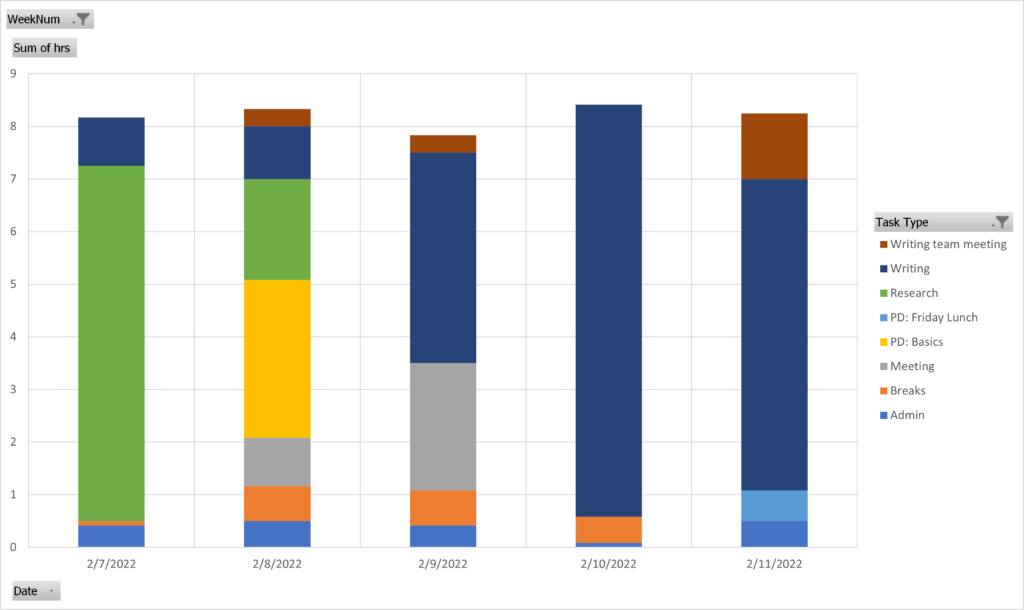
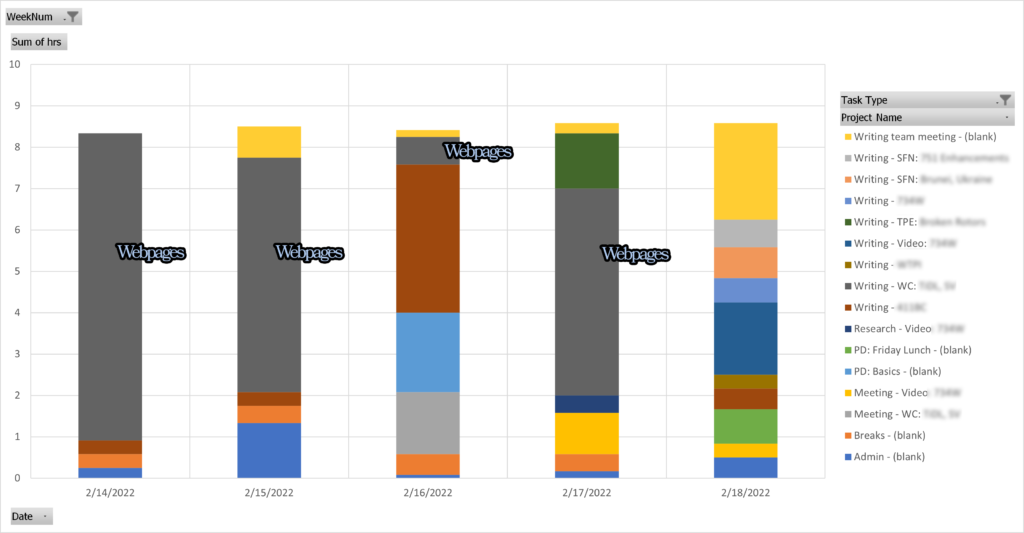
Like I’ve mentioned before, not all of the projects I work on can be shared until they’re done, so there’s some redaction above. I’ve tried to retain some of the labeling I use to differentiate project types though: WC for Web Content, SFN for an internal news article, TPE for an email about a new technical paper. I have a lot of writing going on. Not only did I spend nearly 35 of the 40+ (not quite 45) hours in the office this week working on some writing project, I also had a few hours of meetings about writing, writing processes and the stuff that the writing team does.

But, at the same time, most of those days are consistent in the task I’m getting to work on. I mean, a single project (writing some web content) is about 20 of those hours, chunked out in 5-7 hours at a time over three days.

That task isn’t done. It’s going into peer review next week. Maybe let’s talk about that.

All That Time… for an Outline?

Ultimately, the thing I produced out of that dark grey time was a four-page, bullet-point outline about what I’m thinking the web content will be about. It has to get through some subject-matter expert (SME) review. This is a task I used to assign in introductory technical writing tasks, so it’s not really unreasonable.

On Friday, I sent it up to the person in charge of the project for review. In total, my outline was about 3000 words. On Monday, it was about 6000 words. This is something that I was told I might work on during my first week here, seven weeks ago, and I’ve been reading technical papers and product specs, watching webinars, taking classes and otherwise preparing like crazy to write this stuff. Getting down to 3000 words of bullet points was rough.

In the meantime, some of these other, smaller projects have intersected some of that subject matter, so I’ve gotten to use the info I’ve picked up. And, those smaller projects have found their way back into this outline.

I probably can’t keep up that pace, though, since there are new things coming my way that will also need a lot of writing time.

Taking Breaks?

I still can’t quite bring myself to stop and take breaks or even take a whole hour for lunch. That habit is going to be rough to break. I taught a lot of midday classes and attended a lot of midday meetings. My office hours were usually tucked right into the middle of those things (every term, I intended use them for lunch, but always got busy). If I ate lunch, it was in a hurry in whatever gap of time I could find, or it didn’t happen at all.

Stopping to just chill for 15 minutes every few hours is also… weird. I try to force it in by getting coffee frequently enough that I have to make new coffee, scattering a 15 minute break into a lot of short walks over four hours.

But, hey, that’s led to a side benefit…

My Bodyweight in Coffee

A few years ago the university I worked at finally had money in the budget for merit raises. The first time ever since the merit raise policy was put into effect a little over a decade earlier. There was a rubric and a ranking system. Everyone was rated out of 3 points, but you could get 4 if your chair thought you did really great in one of the three categories we were evaluated on (teaching, university service, scholarship).

I got a 5 out of 3. I didn’t work for the merit raise. I just wanted to be a good teacher and a good colleague.

Averaged out over the 36 weeks of my annual contract (9-months), that merit raise equaled one Dutch Bros. basic Americano a week, for three weeks of each month.

That… kind of made the merit raise a little bit of an insult, especially when the money was put into that pool instead of into things that faculty were asking for. To be fair, the chairs of most departments made sure that everyone was highly recommended, so the raise was distributed pretty evenly across the faculty. It made it clear, though, that dumping my life into my job was only going to be rewarding insofar as I enjoyed putting my life into my job. I did, but then that became the baseline expectation for the next evaluation. I mean, if you’re not getting 30% better every year, what are you even doing, amirite?

So, anyway, I tell that story to make this point: I supplied my own coffee when I taught, either by driving through Dutch Bros. on the way to campus or by bringing my own coffee grounds and making a pot in the break room. In the seven weeks I’ve been here, I’ve consumed at least the same annual allotment that my merit raise bought, just in break room coffee.

It’s small, but it’s the little things that are really making the difference.

Striking Ink

Well, it took some time, but the writing assignments have arrived. I mean, there were writing tasks before this week, but things hit hard this time around. Writing (the dark blue) really exploded later in the week, and the research leading up to some of that writing took up a big chunk of the front of my week.

But, that chart isn’t really helpful in saying what a content writer does, which is the whole point of these posts. I mean, of course I write, right? But, like the Bobs are asking above, what would I say it is that I write around here?

Big Things Afoot

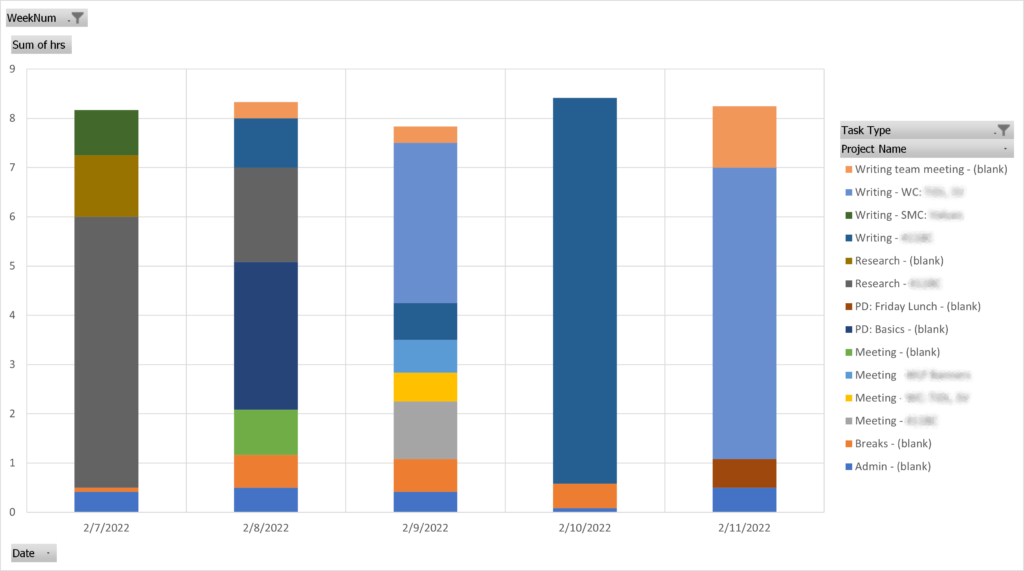
It might be more helpful to break these tasks out by individual project. The spreadsheet I use to track my time includes tags for the task I’m doing (like Writing or Research) along with specific projects that task might be for. Unfortunately, some of those projects are for products or other things that haven’t been announced yet, so there’s some redaction below.

So, there’s a few writing projects up there. One is purely web content (some pages about a product family and some industry stuff), one is a social media campaign (which I’ve got a blurb about over at my how-to site, RhetoricalStuff.com), and the other is a bigger project with a lot of different parts.

Wednesday became pretty chaotic, since two of those projects kicked off that day. There’s a lot of lead-time before some projects begin, and since I’m still new around here, folks have made sure to give me plenty of warning when something is going to get assigned to me. The web content project is something that I was told about over a month ago, so it got moving pretty quick. The bigger project was announced last Friday, so I had a chance to start researching it Monday and Tuesday.

You might notice that my ability to take breaks is still basically non-existent. That’s a me problem more than anything. I’m still working on finding a groove, and last week, I packed lunches that were a little too easy to eat while I worked.

Writing for Web Content (~10 hours, including meetings)

Writing for the web is fun. I used to teach it. (I don’t know if that link will remain live for much longer, but I’m still paying for the domain, so ¯\_(ツ)_/¯). This project is a little more challenging because the stakes are different than, say, a blog, but most of the moving parts are still there. It’s a little more like technical writing than most web writing: I have an audience with a problem, and I need to get them the information or resources necessary to solve it. Like web writing, though, I have to assume my audience has a short enough attention span that they’ll go back to Google if they don’t find their answer quickly.

I’ll hold off on detailing this one too much until the content is live, then I’ll document things over at Rhetorical Stuff. For now, I’ll just say that the approach is very much like starting a technical writing task.

Writing for Social Media (1 hour, finalizing)

Writing for social media is tough. I was asked to generate a number of social media posts and find some content to link for each one. The challenge was something that we talk about in summary writing assignments: each platform gives you a different amount of space before truncating or rejecting your post. Companies pay big money for analytics that tell them that a …See More tag is rarely clicked, so the entire message has to fit in a few dozen words (25 for Facebook and LinkedIn, about 160 characters on Instagram, 200 characters on Twitter). We have social media managers who handle the social posts, but the Writing team sometimes gets to generate base content for them.

When your employer produces things that offer “high-speed distance and directional protection” in electrical relays, that limit arrives pretty quickly.

Now, add other analytics-based restrictions (like not mentioning the company name and linking content that’s still fresh for social media shares), and you’ve got a fun challenge.

I started this project over a week ago, and it’s just in the finishing stages now. I’m hoping I’ll have some posts to share in the coming weeks.

Bigger Project (~17 hours)

The big project took the majority of my time. I’m mostly revising existing documents, but I’m writing about a product and features that I’m just learning about (remember all that research time on Monday?) On Thursday, I worked through a few documents pretty closely to update all the differences between a few configurations and, in one document, emphasize how they fit the needs of various customer groups.

This has been a fun project, even if it’s a little higher stress than the rest. It’s on a pretty tight timeline, so like the social media posts, I’m hoping to have something to share here before much longer.

Not Exciting?

This was the big transition week. No one said anything, but it’s the thing everyone described: suddenly, there will be lots of stuff to do. The question now might be how I can manage it. In academic settings, you work on academic time. As a student, once the term or the semester is over, it’s done. Everything is graded, and you can throw away what’s left of the to-do list. As a teacher, the entire list can’t be thrown away (there are institutional reports and projects to work on, courses to plan, assignments to tweak, etc.), but the end of a term is still a punctuation mark.

I don’t have that anymore. The juggling continues, and the only break I’m going to get is the one I build by finishing my tasks.

Well, that and the other break that I came here for: everything is still done at 5pm. When I came home on Thursday, I did exactly zero work. Hell, when I came home last Friday, when I’d been told about the new Big Project coming my way, I did zero research or preparation for it. I made a note on my work computer where to begin on Monday morning, and that’s what I did.

Bored out of my gourd, and I’m loving every minute of it.

A Month In

Well, I’m a month in to the new gig. I’m writing full time (sort of, see below). I’m not teaching (sort of, see below). Administrative and research duties have disappeared (…see below), and I’ve got tons more time to spend with my family (😔). Things are great, right?

Writing Full Time?

The big thing I grew to dislike about working in academia was working on “academic time.” If you’re a student or a teacher, you know it. It’s the sense that everything starts with an academic term (a quarter, a semester, a grading period, whatever you want to call it) and ends when final grades are submitted. On one hand, it’s nice to get a clean slate every few months, but on the other, the system really doesn’t allow for projects that fall outside those neat boundaries.

Case in point: I did academic assessment as part of my institutional service. To assess the quality of an academic program, you have to collect data, and most people like to collect student performances on final projects. Know when they don’t want to spend time gathering those examples of student work, explaining their assessment strategy and writing up the results? If you answered “after the term was done,” you were correct. Know when the best time is to do that stuff for final projects?

There are plenty of other examples out there — the research projects perpetually half finished because you can only get so much done in the week or two between terms, the courses that are always half planned because you split your breaks between course prep and research, the vacations only a quarter taken because you spent your break working on stuff you didn’t have time to do during your work hours because there was too much work to get any work done. Sucks.

Well, now I’m writing full time. There are no seasonal starts and stops where everyone begins or ends the work they’re doing. Everything is perpetually ongoing. It’s like a big ol’ writing train, cruising on by. And, I’m grabbing at the cars as they go to get projects here and there.

A lot of my time lately has been spent preparing, researching, reading, planning… not quite writing. I can’t say I don’t like it, though. I’m getting to do a thing I haven’t been able to do for a long time: sit and prepare to take on a major project. I’m able to ask others for advice (and get it!). I can look at examples of similar work. Even more mind-boggling: I’m writing about subjects that I don’t have a lot of subject matter expertise in, and my employer is paying me to watch lectures and read papers on the subject.

I’ve learned a lot about power substation design in the last four weeks, and I know I have only just gotten past the surface.

But you know what we always said in writing classes? The writing process is more than just the time you spend hastily slapping at your keyboard to reach a word count. The writing process begins with research and planning, even for the smallest tasks.

So, I’m not pounding out 10-15 pages a day like I did at the height of my dissertation. Today, I spent 5-6 hours of my work day producing about as many good social media posts. I’ll get a lot more done tomorrow, but writing full time has really meant devoting all of my time to the writing process.

No More Teaching

For the first time since the summer of 2008, I have no classes assigned to me.

Wow, that makes me feel kind of old.

For the first time since… I don’t know, 1990? Somewhere around there. For the first time since then, the largest share of my time isn’t being spent in a classroom.

Now, teaching is a hard habit to break, so I’m spending a lot more time prepping and writing content for the website I started building to house my IP, rhetoricalstuff.com. I assumed it was going to happen. You can’t just quit something you’ve been doing for a third of your life cold-turkey. But, I assumed I was going to go back through old rhetoric texts like I did with Aristotle, but put out annotations and notes for stuff like Burke, Malcolm X, Qutb… The things I always wanted to teach in class but could never find a low-cost textbook for.

But instead, what do I find myself doing? I linked one example above. I’m writing about the writing I do on the job, thinking about how I’d present the same task to students in my Professional Writing or Communication classes.

I don’t have a classroom to go to, but I’m still dealing with that urge to help others learn how to do a thing they might be interested in. But, I definitely don’t have any administrative or research duties. No sir!

Research Finds a Way

It’s like Jeff Goldblum says, “Your research paradigm finds a way.” Or something like that.

In my case, I did a lot of language and writing research, which is what drew me to assessment. Corpus linguistics, success metrics, genre studies… These were things I really enjoyed about grad school and academia. I still do. (I’m one of a small number of people who find r/antimeme genuinely hilarious, mostly because the posts are able to do the meme genre exactly wrong.)

So, one of the first pieces of writing I was assigned here was an email about a newly released technical paper (a power company in San Diego had trouble figuring out where a problem was on their power lines, and when they fixed it, they found an unrelated but potentially larger problem). I didn’t know much about the audience, except that it was an email list that included basically all interested people who spoke English. (In composition classes, we’d call that “not an audience.” At least, not enough to write something to them.)

There were some ground rules about writing these kinds of emails: subject length, email h1 length, body content length… Most of the focus was on word count as it correlated to success (number of people clicking a link in the email). The applied linguist and comp teacher in me said that can’t be the only thing that impacted people. I mean, raise your hand if you’ve ever decided to click a link in an email just because it had the right number of words.

Now, put your hands down. I can’t see them. You look silly.

So I took the database of email metrics and I scrounged up the body text of every email. I generated a jargon list of industry terms and terms specific to this company, largely based on the emails themselves (word frequency within emails combined with word frequency in American English). I disaggregated the emails by structure type (prose versus list, for instance), by frequency and placement of jargon, by cohesion with subject line and h1 and…

Well, I found myself doing a freaking research project. I don’t know that my findings are conclusive enough to inform best practices (the n of every cluster is too small, the variances in performance too large, and there are just too many unknowns about the audience). You know what my colleagues and I have been doing on Friday mornings for the last few weeks?

That’s right. Talking about my analysis of the emails to update our best practices document.

Family Time

Well, I’m not generating text for 8 hours a day, I’m still finding ways to do instruction, I’m still conducting research, so life isn’t too different. One thing that is definitely different is that I work eight hours per day. In fact, I asked my supervisor a question about getting access to the organizational MS Teams space on my phone because there was a social group I wanted to engage with, but I didn’t think I should do it during my working hours.

I was given a hard no. I was told (not suggested) that my time was my time, and outside of work, I should not engage with anything like work. Later, she also thought it might be a violation of company IT policy to connect an outside device to the network.

Part of this was because, during my interviews, I said that I was leaving academia because of work/life balance issues. The fact that I did a video-call interview on “Thanksgiving vacation” from my office (because I had work to do that day) probably telegraphed more information than I wanted it to.

Unfortunately, packing up and moving a family of four plus pets when you’re used to working on academic time isn’t really doable. I’m living in my wife’s parents’ basement and commuting an hour each way (in good weather) to work. She has the kids (and pets) down in Oregon and is trying to finish getting the house ready to sell. I get 20-30 minutes of video-chat time with the kids each night.

Now, here’s the part where reader response is really important, because this is either sad or heartwarming. Those 20-30 minutes are more quality time per day than I got with my kids for the last few years in academia. Whatever device we’re talking on, they are the only thing I’m paying attention to. I’m not worried about things I need to stay up grading after they go to bed, whether I’ve planned my classes for the next day, whether those emails languishing in my inbox can wait another day or two for a response, whether those institutional reports can be turned in a week late, whether this, that or the other.

It’s February 1, and I left Oregon on December 29. I was back home for the weekend before Civil Rights Day (a company holiday) to help pack and move some stuff up to a storage unit here. Including that weekend, I’d say I’ve had about 30 hours of real quality time with my kids, living about 500 miles away. If I was still teaching, I wouldn’t have gotten close to that. I might be physically present in the house more often (well, maybe more often, a scheduling snafu had set me teaching a morning class and a night class, so half of each weekday was going to be spent on campus).

And, you know what? We’ve plotted out the worst-case scenario. We’ll move into a house or apartment in May at the latest, and I’ll be commuting far less (maybe 30 minutes a day if I walk to work). Weeknights are going to be actual family-time now, and weekends… woah. Imagine that. I’ll get a whole two days every week where I’m not expected to catch up on prior week work or get ahead on the next week.

Epilogue

Just because I feel like it’s necessary: I’m not complaining about the new job. I’m still in the honeymoon period, but I don’t see anyone burned out and jaded with the work among my colleagues. I don’t expect things to get Bad in the same way academic jobs do. This post is just something that I realized while I was cruising along the highway at 20 mph behind a semi tonight (very icy, everyone took it slow). I’m still doing many of the skills that were a core part of my academic life, but the context is different. How much more different, we’ll see over time.

css.php